Hotel and Guesthouse Investment in Cambodia: 2026 Guide
Arrivals fell 16.9% while revenue rose 6.6%. What that means for a foreign buyer pricing a guesthouse as a business rather than as a building.
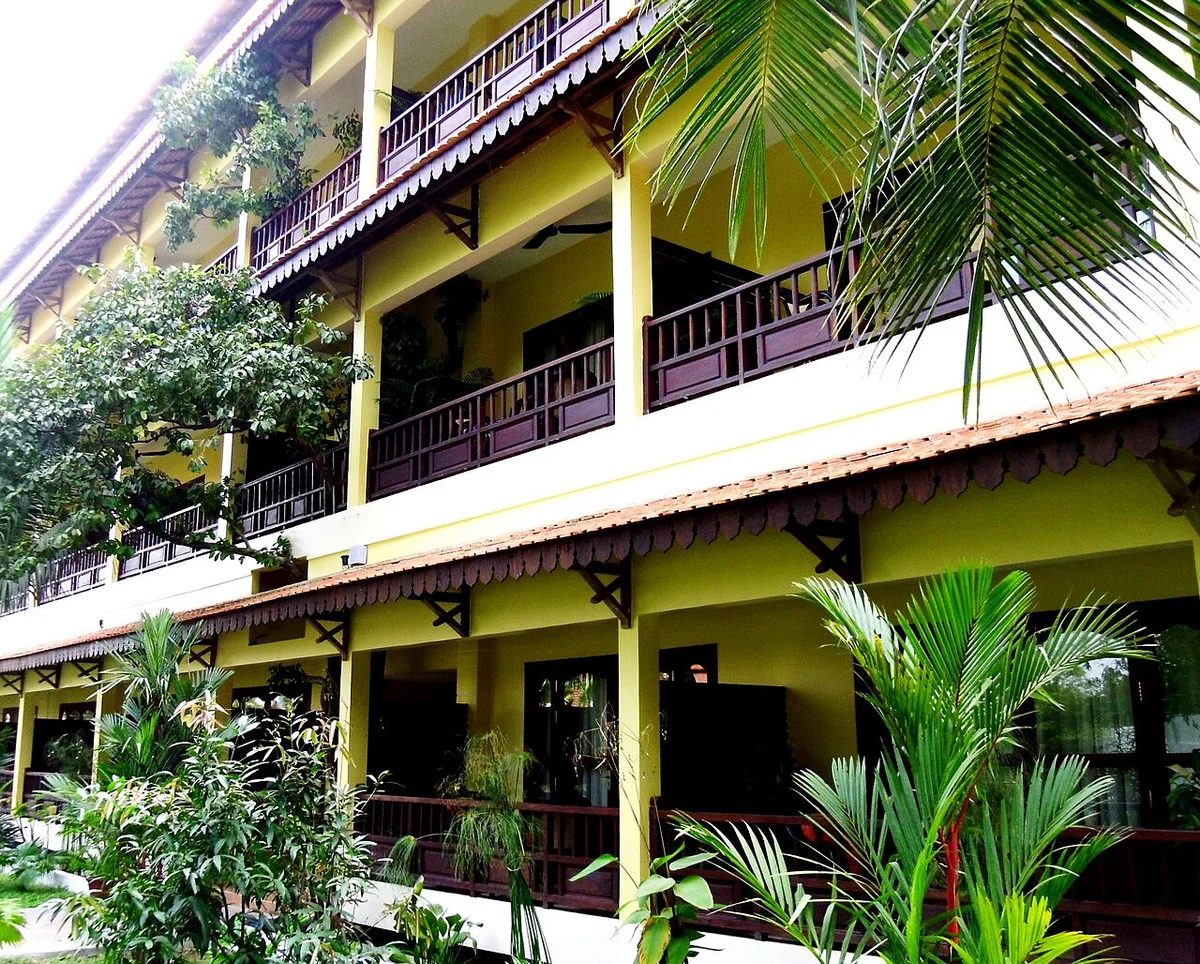
Quick answer: A Cambodian guesthouse is a licensed trading business with a building attached, not a property investment with guests attached. Foreign buyers cannot hold the land freehold, arrivals fell 16.9% in 2025 while receipts rose 6.6%, and the value sits in the operation rather than in the bricks.
Cambodian hospitality is written about almost entirely as a tourism story: Angkor, the coast, arrivals recovering, new flights coming. That is a fine subject and a poor investment brief. A buyer looking at a twelve-room guesthouse in Siem Reap needs to know what the rooms earn, what the staff cost, whether the licence transfers and who actually owns the land, and none of those questions appear in a tourism article.
This page is the investment brief. It states what a foreigner can hold, what the national numbers really say, what a guesthouse costs, and how room revenue compares with letting the same capital as residential property.
Cambodian tourism in 2026 is best understood through two numbers moving in opposite directions. International arrivals fell 16.9% to 5.57 million in 2025, the sharpest volume decline since the pandemic recovery began, while tourism receipts rose 6.6% to $3.878 billion over the same period. Fewer people came and each of them spent more. For an investor that reframes the entire sector: the growth is in rate rather than in heads, which rewards well-located, better-specified properties and penalises volume-dependent budget rooms competing against a national supply of 95,588 registered rooms that did not shrink when arrivals did. Our analysis treats that divergence as the most important input in any Cambodian hospitality purchase made this year, and it changes what a buyer should be looking for on a viewing.
Can a foreigner own a hotel or guesthouse in Cambodia?
Foreign investors cannot own a Cambodian hotel or guesthouse building outright, because the building holds land and land is closed to foreign freehold. What a foreigner can own is the operating business, held alongside a long lease of 15 to 50 years, a landholding company capped at 49% foreign shareholding, or a licensed commercial trust.
| Component | Foreign ownership | Notes |
|---|---|---|
| The land and building | No | Lease, 51/49 company or commercial trust required |
| The operating company | Yes | A foreign-owned Cambodian company can trade |
| The accommodation licence | Held by the operator | Transfers are not automatic on a sale |
| Furniture, fittings and equipment | Yes | Owned by the operating company |
| Brand or franchise agreement | Yes | Contractual, separate from the property |
| Strata unit inside a condotel | Yes, above ground floor | The one freehold-eligible hospitality format |
That last row is the route most foreign investors should look at first and rarely do. A strata unit in a managed hospitality building can be held freehold above the ground floor under the standard rules, which gives hospitality exposure without a land structure and without payroll. Our underwriting treats it as a different asset from a guesthouse purchase, with different risks, but it is the only version of this sector available to a passive foreign buyer.
- The business and the property are two separate acquisitions in one deal.
- Licence transfer is a negotiated condition, not an automatic consequence.
- Payroll, seasonality and guest liability come with the operating company.
- Structure options sit in the lease, nominee and trust guide.
- Land ownership limits are set out in the land ownership guide.
What do Cambodia’s tourism numbers actually say?
Cambodia received 5.57 million international arrivals in 2025, down 16.9% from 6.70 million in 2024, while tourism receipts rose 6.6% to $3.878 billion. The Ministry of Tourism expects 5.6 to 5.8 million arrivals in 2026, and 95,588 accommodation rooms were registered at the end of 2025.
| Indicator | 2024 | 2025 | 2026 expectation |
|---|---|---|---|
| International arrivals | 6.70 million | 5.57 million, down 16.9% | 5.6 to 5.8 million |
| Tourism receipts | Lower base | $3.878 billion, up 6.6% | Not published |
| Registered accommodation rooms | Not stated | 95,588 at year end | Growing |
| Domestic trips | 22.5 million approximately | 25.16 million, up 11.7% | Up 54.2% in January to May |
| Siem Reap guesthouse rooms | 4,552 at end 2024, falling | Not published | Not published |
The divergence between falling arrivals and rising receipts is the single most important fact on this page, and it is genuinely good news for one type of operator and bad news for another. Fewer visitors spending more money rewards higher-rate, better-located properties and punishes volume-dependent budget stock. Our analysis reads it as a market bifurcating by segment rather than a market in decline, which is why a national occupancy average is close to meaningless for pricing a specific asset.
- Revenue growth with volume decline means rate, not occupancy, is carrying the market.
- Budget and volume-dependent guesthouses are on the wrong side of that split.
- Domestic tourism at 25.16 million trips is a real and growing demand source.
- Room supply at 95,588 has not contracted with arrivals.
- No audited national occupancy series exists; every figure quoted is directional.
What does a guesthouse or small hotel cost to buy?
Small Cambodian guesthouse businesses including the building start around $400,000 and run past $1 million in Siem Reap and central Phnom Penh. The price splits three ways between the property, the licence and the trading history, and our analysis prices each separately because only the last two can be tested against evidence.
| Component of the price | Typical share | How to test it |
|---|---|---|
| Land and building | 55% to 75% | Comparable land price per sqm plus build cost |
| Furniture, fittings and equipment | 10% to 20% | Age, condition, replacement cycle |
| Licence and permits | 5% to 10% | Confirm transferability in writing |
| Goodwill and trading history | 10% to 25% | Two years of occupancy and rate data |
| Structure formation, if none exists | $3,000 to $10,000 | Added to the buyer’s cost, not the seller’s |
| Working capital for the first season | $20,000 to $60,000 | Not usually included in the asking price |
The goodwill line is where most disputes happen and where our underwriting applies the most scepticism. A seller quoting goodwill on trading history has to produce that history, and two years of monthly occupancy and average daily rate is the minimum evidence. Where the data does not exist, the goodwill does not either, and the asset is a building with a licence attached rather than a business.
- Ask for occupancy and rate by month, not an annual average.
- Confirm whether staff transfer with the business and on what terms.
- Check the licence is current, in the seller’s name and transferable.
- Budget separately for the first season’s working capital.
- Structure formation is a buyer cost that never appears in the asking price.
Insider tip: ask for the property’s utility bills for the last 24 months rather than its occupancy report. Electricity and water consumption track real guest nights far more honestly than a spreadsheet does, and a guesthouse claiming 70% occupancy on the power usage of a half-empty building has answered the question for you.
Send the location, room count, asking price, licence status and two years of occupancy and rate data. We separate the property value from the business value and price each.
Assess this hospitality assetHow does hotel revenue per room compare with a condo let?
A twelve-room guesthouse at $35 a night and 65% occupancy grosses about $99,600 a year, which on a $500,000 purchase is a headline 19.9%. Our underwriting takes that to roughly 6.4% net once payroll, utilities, platform commission, licensing, maintenance and 14% non-resident tax on gross are applied.
| Line | Annual amount, 12 rooms |
|---|---|
| Gross room revenue, $35 at 65% occupancy | $99,645 |
| Payroll, 6 staff including reception and housekeeping | minus $36,000 |
| Utilities, water and internet | minus $9,600 |
| Platform and agent commission at 15% | minus $14,947 |
| Consumables, laundry and replacements | minus $7,200 |
| Repairs, maintenance and licence renewal | minus $6,000 |
| Rental and business tax exposure, 14% on gross | minus $13,950 |
| Net | About $11,948, or 2.4% on cost |
That result is the reason this page exists. The same $500,000 deployed across residential strata units at a realistic net yield produces materially more with no payroll, no licence and no seasonality, and the arithmetic does not improve until occupancy and rate move together. The comparison against residential yields belongs to the investment buyer guide, and this page does not restate those figures.
- The guesthouse case turns on rate, not on occupancy.
- Payroll alone is roughly 36% of gross revenue at this scale.
- At $55 a night and the same occupancy the net moves to about 8.1%.
- Seasonality means a bad quarter cannot be recovered later in the year.
- Short-term letting of a condo is a different model, in the short-term rental guide.
What does running a licensed accommodation business add?
Running a Cambodian guesthouse adds five obligations no property investment carries: payroll of about $36,000 a year for six staff, an accommodation licence renewed annually, guest registration compliance, $20,000 to $60,000 of seasonal working capital, and daily operational presence. For foreign buyers, those five lines are the difference between owning an asset and holding a job.
| Obligation | Practical weight | Annual cost on a 12-room property |
|---|---|---|
| Payroll and staff management | 6 staff, year-round | About $36,000, or 36% of gross |
| Accommodation licence | Annual renewal, non-automatic transfer | $500 to $1,500 with renewal |
| Guest registration with authorities | Ongoing, per guest, enforced | Staff time rather than cash |
| Seasonal working capital | Low season runs at a deficit | $20,000 to $60,000 held in reserve |
| Operational presence | Daily; remote ownership needs a manager | $9,000 to $18,000 for a trusted manager |
| Guest liability and insurance | Higher exposure than a tenancy | $1,200 to $3,000 |
Absentee ownership is where foreign hospitality investments in Cambodia most often fail, and the reason is structural rather than cultural. A guesthouse generates cash daily, employs six people who are managed daily, and depends on a licence held by someone present. An owner in another country relies on one manager for revenue collection, cost control and compliance at the same time, and our analysis of buyer scenarios in this sector puts a competent, incentivised, verifiable manager as the single largest determinant of outcome. A manager on a $12,000 salary with no revenue share is being asked to protect $99,600 of gross takings on behalf of somebody they see twice a year, and the red flag is not dishonesty but the absence of any mechanism that makes their interests match the owner’s.
- Remote ownership needs a manager with a real incentive, not a salary alone.
- Cash businesses need banking discipline from day one.
- Low season deficits are normal and must be funded, not financed.
- Guest registration compliance is enforced and personal to the operator.
- Management options are discussed in the property management guide.
Which investor does Cambodian hospitality suit?
Cambodian hospitality suits an operator living in the country with at least $500,000 and a tolerance for seasonality, and suits a passive overseas investor poorly. Our analysis puts the dividing line at presence rather than capital: the same asset returns 2.4% net absentee and considerably more when the owner is the operator.
| Investor profile | Fit | Reasoning |
|---|---|---|
| Owner-operator resident in Cambodia | Strong | Payroll saving and control both accrue to the owner |
| Couple relocating to run a small property | Strong | The lifestyle case and the business case align |
| Overseas passive investor | Poor | 2.4% net with maximum operational risk |
| Investor wanting hospitality exposure passively | Redirect | Strata unit in a managed hospitality building |
| Investor under $400,000 | Poor | Below realistic entry for a licensed property with rooms |
The redirect row deserves emphasis. An investor who wants exposure to Cambodian tourism without payroll can buy a strata unit above the ground floor in a professionally managed building and let it through the management company, which is a property investment with a hospitality tenant rather than a hospitality business. That option keeps foreign freehold intact, needs no land structure, and is covered in the serviced apartments guide.
Advantages and disadvantages of hospitality investment
Cambodian hospitality offers the highest gross revenue per dollar of property in this market and the lowest net conversion. The trade is between an operating business that can be genuinely profitable in the right hands and a passive investment that almost never is.
| Advantage | Disadvantage |
|---|---|
| Gross revenue per room far exceeds residential rent | Net after payroll and tax lands near 2.4% absentee |
| Rate-led market rewards quality and location | Arrivals fell 16.9% in 2025, volume is not the driver |
| Receipts up 6.6% to $3.878 billion shows real spend | Room supply at 95,588 has not contracted with arrivals |
| Domestic tourism at 25.16 million trips is growing | Siem Reap volume tourism is still materially weaker |
| Owner-operators capture the payroll saving directly | Requires daily presence and a transferable licence |
| Business can be sold with the property | No foreign freehold on the land under any structure |
Siem Reap deserves its own warning, because it is where most first-time hospitality enquiries point. Visitor numbers to the Angkor complex remain far below their 2019 level, recovery has been held back by limited flight capacity and cancellations rather than by demand alone, and guesthouse room supply at 4,552 rooms at the end of 2024 was itself falling as operators exited, with visitor numbers to the Angkor complex down by roughly 50% against 2019. Luxury properties in the town continue to perform while mass-market stock does not, which is the same rate-over-volume split visible in the national figures but sharper. Our underwriting applies a materially higher occupancy discount to Siem Reap budget stock than to comparable Phnom Penh property, and would want to see flight capacity recovering before pricing any volume assumption into a purchase there, because a 50% volume shortfall is not something a better breakfast offer recovers.
Buyer scenarios and red flags
Three scenarios cover most hospitality enquiries, and the red flags repeat: goodwill without trading data, a licence that does not transfer, and an occupancy figure that the utility bills contradict.
| Scenario | What they want | What we would recommend |
|---|---|---|
| $500,000, overseas, wants yield | A Siem Reap guesthouse | Strata unit in a managed building instead |
| $600,000, relocating to Cambodia | A small hotel to run | Viable; price the business separately from the building |
| $1,200,000, wants a portfolio | Two guesthouses | One asset well run beats two managed remotely |
The failure pattern is a business bought at a property price. A buyer is shown a twelve-room guesthouse at $500,000, is told it runs at 70% occupancy and $40 a night, and calculates gross revenue of $122,600 against the asking price. What the calculation omits is that six staff cost $36,000, that the licence sits in the seller’s personal name and requires a fresh application rather than a transfer, that the low season runs three months at a deficit, and that the 70% occupancy figure was never reconciled to a utility bill. The buyer completes, discovers a net closer to $12,000, and concludes that Cambodian hospitality does not work. It works. It was simply priced as real estate when it is a business, and the two things are valued on completely different multiples.
- Require 24 months of occupancy, rate and utility data before offering.
- Confirm in writing whether the licence transfers or must be reapplied for.
- Price the property, the equipment and the goodwill as three separate lines.
- Fund the first low season in cash rather than assuming it away.
- The wider asset comparison sits in the commercial property pillar.
Regional context for the two main hospitality markets sits in the Siem Reap area page and the Sihanoukville area page.
Tell us whether you will be in Cambodia running it. That single answer changes the recommendation, and we will price both versions of the deal for you.
Talk to our Cambodia deskFrequently Asked Questions
Not the land and building directly. A lease, a 51/49 landholding company or a commercial trust is required. The operating company itself can be foreign-owned.
5.57 million international arrivals in 2025, down 16.9% from 6.70 million in 2024, with 5.6 to 5.8 million expected in 2026 and 25.16 million domestic trips.
Revenue is, volume is not. Receipts rose 6.6% to $3.878 billion in 2025 while arrivals fell 16.9%, which means higher spend per visitor rather than more visitors.
From around $400,000 for a small property with the building, well beyond $1 million in Siem Reap and central Phnom Penh, split between property, licence and trading history.
Indicative readings put national occupancy near 70%, the strongest recent figure close to 78% and provincial markets nearer 60%. No audited national series exists.
They are different businesses. A guesthouse is licensed and staffed with payroll and seasonality; the Airbnb comparison is run separately in the short-term rental guides.
Send location, room count, asking price, licence status and two years of occupancy and rate data. We price the property and the business separately.
Get a Cambodia property shortlist
Share your budget, target district (BKK1, Koh Pich, Koh Norea, Siem Reap), and goal. We reply within one business day with matched stock and next steps.