Commercial Property in Cambodia: Asset Classes and Yields
Strata office, shophouse, SEZ industrial, land, hotel and serviced stock compared on ownership route, entry ticket and realistic 2026 return.
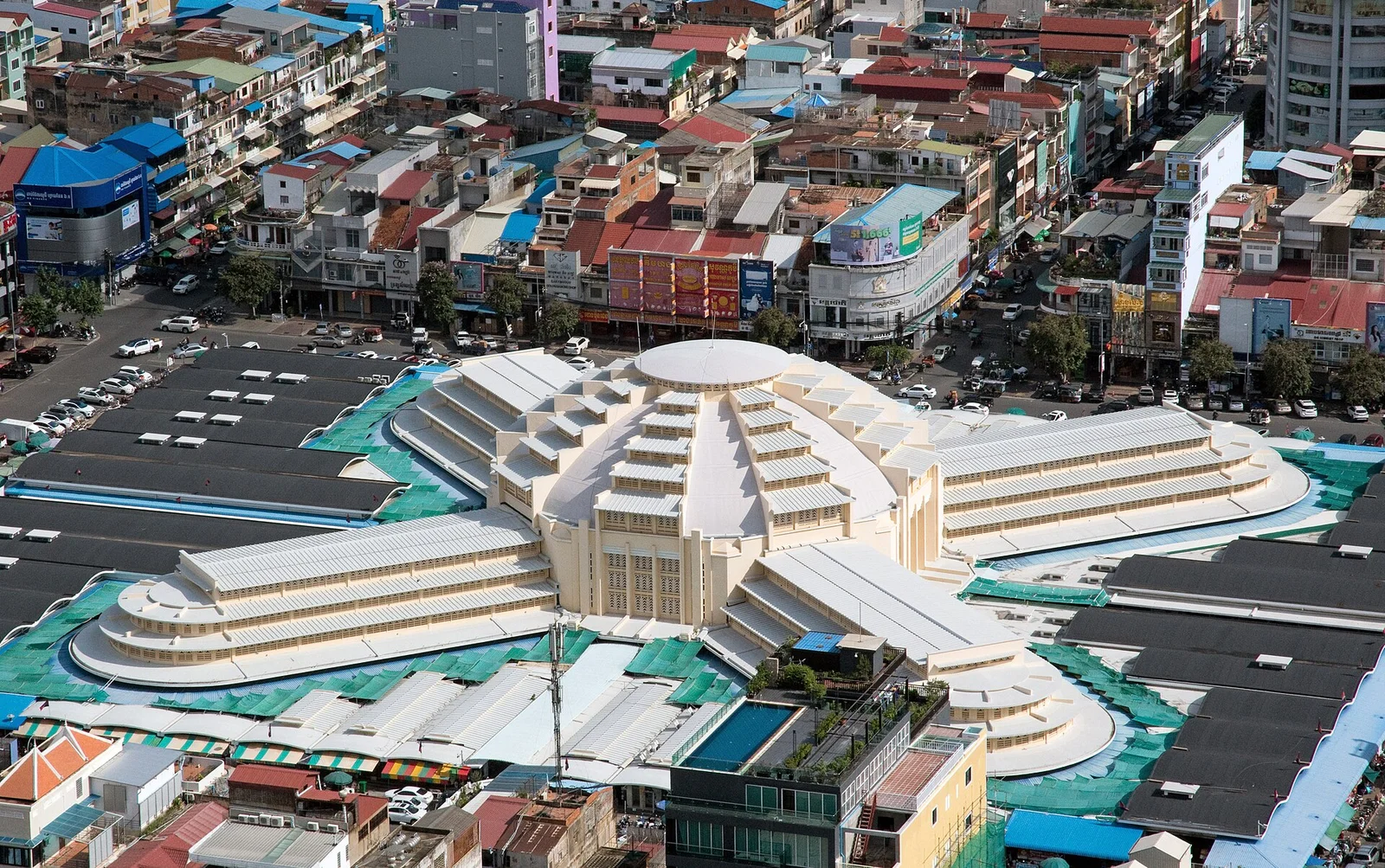

Quick answer: Commercial property in Cambodia splits cleanly into two groups. Strata units above the ground floor, whether office, retail podium or serviced apartment, are open to foreign freehold under the same rules that govern condos. Everything that touches land, from a shophouse to a factory plot, needs a lease, a company or a trust before a foreigner can hold it at all.
Every page on this site before now has described one asset: a residential condo bought by a foreign individual. That is the right starting point, because it is the only asset a foreigner can buy outright with no structure and no local partner. It is also, for a buyer with $300,000 or more and a tolerance for operating work, a narrow view of what the market offers.
This page is the map. It states which commercial asset classes a foreign investor can legally hold and by what route, what each one costs to enter on 2026 numbers, and what each realistically returns once the vacancy picture is included rather than assumed away. Each asset class then has its own page with the full cost stack, and this page links to all of them rather than repeating their tables.
Can foreigners buy commercial property in Cambodia?
Foreign buyers can own commercial space in Cambodia, but only where that space is a strata unit above the ground floor. The Law of 24 May 2010 read with Sub-Decree No. 126 (2009) caps foreign ownership at 70% of the total area of all private units in a co-owned building, and that cap applies to a commercial building exactly as it applies to a residential tower.
| Asset | Foreign freehold? | Route if not |
|---|---|---|
| Strata office floor above ground level | Yes | Not needed |
| Strata retail unit above ground level | Yes | Not needed |
| Ground-floor retail or office | No | Lease from the landowner |
| Shophouse, villa office, guesthouse building | No | Lease, landholding company or trust |
| Factory plot or SEZ land | No | Long lease inside the zone |
| Development land | No | Landholding company or commercial trust |
Ground floor is the line that surprises people. A ground-floor unit is treated as sitting on the land, so it stays outside the foreign strata quota no matter how the building is marketed. That single rule removes most street retail from the freehold conversation and pushes it into the structure conversation, which is why our underwriting treats a ground-floor offer at a freehold price as a red flag rather than a bargain.
- Strata title above the ground floor is the only structure-free commercial route.
- The 70% cap is measured on total private-unit area, not on the number of units.
- Commercial leases commonly run to 50 years and are renewable.
- A perpetual lease runs 15 to 50 years with automatic 50-year extensions.
- Full eligibility detail sits in the foreign ownership guide.
Which commercial asset classes are open to foreign capital?
Seven commercial asset classes are open to foreign buyers in Cambodia, and they divide three ways: four are freehold-ready inside the 70% area cap, two need a structure costing $3,000 to $8,000 to form, and one is a licensed trading business. Sorting an opportunity into the right group before discussing price is the most useful thing our analysis does on a first call.
| Asset class | Group | Indicative entry | What a foreign investor is actually buying |
|---|---|---|---|
| Strata office | Freehold-ready | From $120,000 | A leasable floor in a graded tower |
| Serviced and branded apartments | Freehold-ready | $120,000 to $250,000 | A residential unit with an operating layer |
| Retail podium unit | Freehold-ready above ground | From $150,000 | A tenancy in someone else’s footfall |
| Branded residence | Freehold-ready | 30% above the unbranded comparable | A managed unit with a licensing agreement |
| Shophouse and street retail | Needs structure | Median $525,000 | Land plus a building, held indirectly |
| Development land | Needs structure | $1,100 to $2,000 per sqm | A carrying cost with an appreciation thesis |
| SEZ industrial | Needs structure | About $3 per sqm per month | A long zone lease, usually as an operator |
| Hotel and guesthouse | Business | $400,000 upward | A licensed trading business with real estate attached |
That third column is the part sales material leaves out. A guesthouse is not a yield asset that happens to have guests; it is a staffed business with licensing, payroll and seasonality, and our underwriting prices it as one. The same logic applies in reverse to strata office, which looks intimidating and is in fact the closest thing on this list to a condo purchase with a longer lease attached.
- Freehold-ready classes need no local partner and carry no annual structure cost.
- Structured classes add $3,000 to $8,000 of set-up plus recurring annual compliance.
- Business classes need an operator, and the operator is usually the real investment.
- The 70% total-area cap applies to all four freehold-ready classes without variation.
- Each class has its own page on this site with the full cost stack.
What does each commercial asset class cost to enter?
Entry tickets across Cambodian commercial property run from roughly $120,000 for a Grade B strata office floor to $525,000 at the shophouse median, with SEZ industrial priced as a rent rather than a purchase at about $3 per sqm per month. All figures below are indicative agency and listing bands, not audited transaction data, and every one moves with the specific building.
| Asset class | Indicative entry | Basis |
|---|---|---|
| Strata office, Grade B | From about $120,000 | Small floor plate, listing band |
| Strata office, Grade A | From about $350,000 | Prime tower, listing band |
| Shophouse | $250,000 to $1,050,000, median $525,000 | Aggregator listing set |
| Serviced apartment unit | $120,000 to $250,000 | Prime district strata pricing |
| Branded residence | 30% above the unbranded comparable | Savills global city premium |
| SEZ ready-built factory | About $3 per sqm per month | Tenancy, not purchase |
| Development land, outer districts | $1,100 to $2,000 per sqm | Phnom Penh land reporting |
| Guesthouse business | $400,000 upward | Building plus licensed operation |
The pattern in that table is worth naming, because it decides who this market is for. Commercial entry in Cambodia begins roughly where the residential market ends. A buyer with $150,000 has a wide condo choice and one realistic commercial option; a buyer with $500,000 has the whole list. Our analysis of enquiry patterns is that the crossover point sits near $250,000, below which the operating work of a commercial asset rarely pays for itself.
- Structure set-up adds $3,000 to $8,000 before any purchase for land-holding assets.
- Annual compliance on a structure runs on top of that, every year it is held.
- Fit-out contributions to a commercial tenant are normal and rarely quoted upfront.
- Transfer tax at 4% of assessed value applies as it does residentially, per the closing costs guide.
Insider tip: ask the seller for the strata title certificate and check the unit’s floor number on it, not on the brochure. Podium levels are frequently marketed as first floor when the title records them as ground, and that one word decides whether a foreigner can hold the unit at all.
Send the asset type, the asking price and the title document. We return the ownership route, the realistic net return and the due diligence that asset actually needs.
Review my commercial opportunityHow do commercial returns compare with a Phnom Penh condo?
Commercial assets in Cambodia quote higher gross yields than condos and deliver a wider range of net outcomes. Shophouse gross yields are quoted above 5%, strata office can pencil above that on a Grade B floor bought well, and both carry void risk that a residential unit in a liquid district does not. The spread is real, and so is the variance.
| Measure | Phnom Penh condo | Commercial asset |
|---|---|---|
| Tenant search time | Weeks | Months, sometimes quarters |
| Lease length | 12 months | 3 to 5 years, sometimes longer |
| Void cost when it happens | One or two months of rent | A quarter or more, plus incentives |
| Fit-out contribution | None | Common, often one to three months of rent |
| Valuation basis | Comparable units | The tenancy and its covenant |
| Buyer pool at exit | Broad | Narrow |
The honest summary is that commercial property trades certainty for headline yield. A condo in a liquid building produces a predictable number that our underwriting can forecast within a few percent. A commercial asset produces a better number when it is let and a much worse one when it is not, and in a market where retail occupancy sat at 57% in the first half of 2026, the unlet case is not hypothetical.
- Residential gross and net yield ranges stay in the investment buyer guide.
- District-level residential yields sit in the district yield comparison.
- The deduction method applies to both, and lives in the net versus gross guide.
- Rental income tax is charged on gross rent under both, at 10% resident and 14% non-resident.
- A commercial buyer scenario should always model a full quarter of void, not a month.
Commercial underwriting in this market rewards patience over yield chasing, and the arithmetic behind that claim is simple enough to state in one place. A Grade B strata office floor bought at $120,000 and let at $18 per sqm per month across 80 sqm produces $17,280 of annual gross rent, which is a headline yield of 14.4% and the number that appears in sales material. Apply a realistic three-month void every third year, a service charge the owner carries while empty, a fit-out contribution of two months on each new tenancy, agency fees at one month, and 14% non-resident rental income tax on gross, and the same floor produces closer to $9,400 net in an average year. That is 7.8% on cost, which is still ahead of a condo, and it is the figure our underwriting uses rather than the one on the brochure.
What does commercial due diligence add to a residential checklist?
Commercial due diligence requires everything a condo purchase requires plus four items foreign buyers never meet residentially: the tenancy, the structure, the licence and the land. Each can end a deal alone, and each costs $500 to $2,000 to check before an offer against a five-figure loss discovered after a deposit.
| Additional check | Why it matters | Where it usually fails |
|---|---|---|
| Existing tenancy and covenant | The valuation rests on it | Verbal terms, no registered lease |
| Structure integrity | Decides whether you control the asset | Dormant company, unclear share register |
| Operating licence | Decides whether the business can trade | Licence in a previous owner’s name |
| Land title behind the building | Decides whether the sale can complete | Soft title, unresolved boundary |
| Fit-out and reinstatement obligations | Decides the true exit cost | Never documented |
| Service charge history | Decides the holding cost | Arrears carried by the unit |
The structure check is the one foreign buyers most often skip, and Prakas 117 made it more consequential. From 8 January 2026 a company using the word Holding in its name must have at least three registered Cambodian subsidiaries and business code 642, which invalidated a generation of dormant single-purpose vehicles overnight. Our underwriting now treats a pre-existing structure as a liability to be examined rather than a convenience to be inherited, and the checklist below is the minimum scope. Legal fees on a commercial purchase run $2,000 to $6,000 against $1,000 to $3,000 residentially, and that gap buys exactly these four checks.
- Title verification follows the due diligence process guide.
- Soft title on a commercial plot is a stop, per the title comparison.
- Structure options are compared in the lease, nominee and trust guide.
- Land ownership limits for foreigners sit in the land ownership guide.
- Budget for a commercial lawyer, not a conveyancer; the scope is genuinely different.
Which commercial asset suits which investor?
Asset choice in Cambodian commercial property is decided by three inputs and not by yield: how much operating work the investor will do, whether a structure is acceptable, and how long the money can stay put. Our analysis of buyer scenarios in this market puts most investors into one of four profiles, and each profile has a clear best answer.
| Investor profile | Best fit | Avoid |
|---|---|---|
| Overseas, passive, $150,000 to $300,000 | Strata office or serviced apartment | Guesthouse, land, SEZ |
| Overseas, passive, above $500,000 | Grade A strata office, branded stock | Shophouse without a structure review |
| Resident in Cambodia, operating capacity | Guesthouse, shophouse retail | Development land with no timeline |
| Long-horizon, patient capital, ten years | Land banking through a reviewed structure | Anything needing quarterly attention |
The profile that struggles most is the overseas passive investor attracted by a shophouse yield. The asset requires a structure, the structure requires local compliance, the tenant requires local management, and the exit requires a buyer willing to inherit all three. That is a viable investment for someone in Phnom Penh and a difficult one for someone in London, which is the sort of judgement our underwriting is meant to surface before a deposit rather than after.
- Passive plus offshore points toward strata, always.
- Operating capacity plus residence opens the whole list.
- A ten-year horizon is the minimum for any land-holding thesis.
- Every profile above should read the asset-specific page before making an offer.
Advantages and disadvantages of the commercial route
Commercial property in Cambodia offers a genuinely different risk profile from the condo market, and the trade is legible once both sides are on the page. Longer leases and higher headline yields sit against thinner liquidity, structure costs and a vacancy backdrop that currently favours occupiers in both the office and the retail markets.
| Advantage | Disadvantage |
|---|---|
| Leases of 3 to 5 years against 12 months residentially | Voids measured in quarters, not weeks |
| Headline yields above the residential band | Fit-out and incentive costs rarely quoted |
| Tenant covenants can be genuinely strong | Buyer pool at exit is small |
| Very little foreign competition for stock | Structures needed for most land-holding assets |
| Tenant’s market means real negotiating room | Falling asking rents cut the owner’s side too |
The negotiating point deserves emphasis because it is the strongest argument for entering this market now rather than in a stronger cycle. Office asking rents are roughly 20% below their 2019 level and retail asking rents fell again between the second half of 2025 and the first half of 2026, which is bad news for an owner already holding stock and good news for a buyer setting an entry price. Our underwriting treats the current cycle as an entry-price opportunity rather than an income opportunity, and those two things call for different behaviour: patience on price, conservatism on rent, and no assumption that today’s vacancy resolves on the timetable a broker suggests.
Buyer scenarios and red flags
Three scenarios cover most commercial enquiries we see from foreign investors, and the red flags repeat across all of them: a ground-floor unit sold as freehold, a yield quoted before a void assumption, and a structure presented as a formality rather than an ongoing obligation.
| Scenario | What the buyer wants | What we would actually recommend |
|---|---|---|
| $200,000, passive, wants above 8% | A shophouse | A Grade B strata office floor, no structure |
| $600,000, lives in Phnom Penh | A guesthouse | Guesthouse is viable; price it as a business |
| $1,000,000, ten-year horizon | Development land | Land through a reviewed structure, plus a strata income asset |
The failure pattern in Cambodian commercial property is not fraud, it is arithmetic. A buyer is shown a shophouse at $525,000 producing $2,800 a month, calculates 6.4% gross, and buys. What the calculation omitted is the landholding company that had to be formed and is maintained annually, the three months the previous tenant left the unit empty, the fit-out contribution the next tenant negotiated, and the fact that resale requires finding someone who wants both the building and the vehicle holding it. Run those lines and the 6.4% becomes something closer to 4%, on an asset materially harder to sell than a condo at half the price. The asset was not mis-sold. The yield was simply quoted before the costs that make it a commercial asset rather than a residential one.
- Any commercial yield quoted without a stated void assumption is a headline, not a return.
- Ground floor marketed as freehold to a foreigner is a stop, every time.
- A structure with no named local counterparty and no compliance budget is a liability.
- Guaranteed commercial returns deserve the scepticism set out in the rent guarantee warning.
- Exit planning starts at purchase, per the exit strategy guide.
Each asset class on this page has its own guide with the full cost stack and the specific checks it needs: strata office, shophouse and retail, SEZ and industrial, land banking, hotels and guesthouses, branded residences and serviced apartments.
Tell us the budget, whether you can be in Cambodia, and how long the money can stay put. We name the asset class that fits and the two that do not.
Talk to our Cambodia deskFrequently Asked Questions
Office, retail and mixed-use units on strata title above the ground floor are open to foreign freehold, inside the 70% total-area cap. Anything that holds land directly is not.
Strata office, strata retail above ground level, and serviced or branded strata apartments. Shophouses, guesthouse buildings, factory plots and land need a lease, a landholding company or a commercial trust.
A Grade B strata office floor from roughly $120,000 on an indicative basis. Below that, a residential condo let to a business tenant is usually the better route.
Headline yields are higher and net outcomes are wider. Longer voids, fit-out contributions and structure costs take back much of the gap.
Vacancy. Retail occupancy was 57% in the first half of 2026 and office stock is heading toward 1.3 million sqm, so owners underwrite voids rather than headline rents.
Yes. The buyer pool is smaller, valuation follows the tenancy rather than comparable units, and a structured asset needs a buyer willing to inherit the structure.
Send the asset type, asking price, title type and any existing tenancy. We return the ownership route, the realistic net return and the due diligence that asset needs.
Get a Cambodia property shortlist
Share your budget, target district (BKK1, Koh Pich, Koh Norea, Siem Reap), and goal. We reply within one business day with matched stock and next steps.