Axis Residences Review: 7 Years of Evidence in Sen Sok
Spring CJW's Singapore-designed 566-unit complex, completed 2018. Why launch-era prices mislead and what 7 years of operation lets you verify.
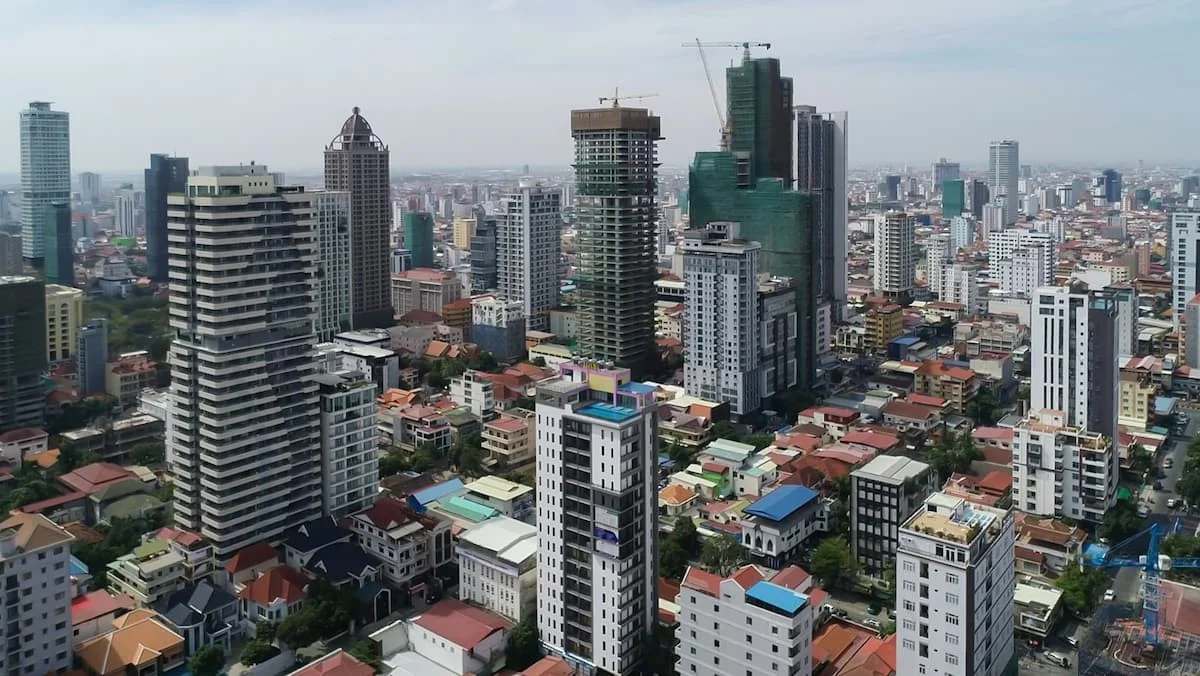
Quick answer: Axis Residences is Spring CJW Development’s Singapore-designed complex in Teuk Thla, Sen Sok, 566 units in 8-10-floor blocks, completed November 2018, with a 50-metre pool and full sports grounds. Seven years of operating history make it one of the few foreign-marketed schemes you can judge on evidence. Price it from the district’s $1,200-$1,800 per sqm, never from the 2016 launch sheet.
Most coverage of Axis still quotes its 2016 fact sheet. This page treats the building as what it now is, seven years of operating evidence in a district with its own settled numbers, and applies the corpus’s verification discipline: verified, claimed, must-obtain.
What is Axis Residences and who built it?
Axis Residences is a Singapore-designed complex in Teuk Thla, Sen Sok, 8- and 10-floor blocks holding 566 units over 566 parking spaces, completed in November 2018 by Spring CJW Development. The grounds are resort-grade, including a 50 m pool, and the scheme gives the developer’s claims something rare: 7 years of checkable operating history.
| Fact | Verified position | Note |
|---|---|---|
| Developer | Spring CJW Development Pte Ltd (Singapore) | Singaporean consultants throughout |
| Completed | November 2018 | Seven years of operation |
| Scale | 566 units, 8- and 10-floor blocks | Low-rise density, rare in this tier |
| Parking | Over 566 lots | One-per-unit-plus, genuinely unusual |
| Amenities | 50 m pool, tennis, basketball | Inspectable for real wear today |
| Phase 1 builder | Sanwah Construction | On the contractor’s public portfolio |
Our read of the complex starts with its format, because the format is the moat: 8- and 10-floor blocks across landscaped grounds is a density decision no Phnom Penh developer has repeated at this scale since, towers pencil better, and it is exactly what produces the complex’s owner-occupier stability and its family tenancies. The delivery story holds up as a case study in what Singaporean process buys: completion on a 2018 schedule, a parking ratio above one per unit in a city where central towers ration spaces, and sports amenities, the 50-metre pool alone is 1,000-plus sqm of maintained water, sized for actual use rather than brochure photography. The honest limits belong in the same paragraph: Teuk Thla is a local district whose tenant base comes from its own economy; the buildings are now seven years old, and from here their maintenance record decides their next decade; and the launch marketing’s price sheet, still circulating, describes a market that no longer exists. All three limits are checkable, which is the point of buying here. The numbers frame the visit: launch tickets ran from about $99,760 in 2016, the district now trades at $1,200 to $1,800 per sqm, typical one-bedrooms sit near 50 sqm, and the complex has had 7 years to prove whether its $1.50 per sqm monthly service charge bought maintenance or deferral.
- The district in full: Sen Sok area profile.
- The mall-anchored comparison: Aeon Mall Sen Sok Residence.
- Why completed stock wins on evidence: new build vs resale.
- The valuation method: resale valuation guide.
- The city shortlist: best condos to buy 2026.
How does foreign ownership work here?
Foreign buyers can hold Axis Residences units above the ground floor in their own name under strata co-ownership, inside the 70% cap on total private-unit area. Seven years after completion, the quota ledger is a settled document, and in a 566-unit complex marketed abroad since launch, requesting it in writing is not optional diligence.
| Ownership item | Position here | What to demand |
|---|---|---|
| Legal basis | Strata co-ownership, Sub-Decree 126 | Certificate copy |
| Foreign cap | 70% of total private-unit area | Dated ledger extract in sqm |
| Launch marketing | International from 2016 | Foreign share may run high, verify headroom |
| Title | Individual strata title per unit | Land Office check on the specific title |
| Transfers since 2018 | Multiple owner generations possible | Encumbrance search is essential |
| Seller identity | Owners abroad are common | Power-of-attorney verification if not present |
Our analysis flags the quota question as this building’s most under-asked item, and the checklist deserves stating in order of what can actually go wrong. A complex sold internationally since 2016 can carry a foreign ledger far closer to the 70% area cap than a locally-sold tower ever would, and a resale from a Cambodian owner to a foreign buyer needs headroom, whereas foreign-to-foreign transfers ride the existing allocation; which of those a specific deal is determines whether the cap matters at all, and only the ledger extract answers it. Second: seven years of transfers means seven years of potential encumbrances, so the Land Office search is doing real work here. Third: absent overseas sellers transact through powers of attorney routinely, verify the instrument itself as well as the signature. Every item is a document; none is a judgment call; and a seller who resists producing any of them has answered a different question.
- The legal baseline: can foreigners buy property in Cambodia.
- The cap explained: foreign ownership and strata title.
- The process end-to-end: due diligence step by step.
- Fraud patterns to exclude: property scam checklist.
- The paperwork of transfer: strata co-ownership registration.
What does 7 years of history let you verify?
7 years post-handover means the evidence a buyer typically guesses at is available here. Occupancy can be counted window by window, the grounds and the 50 m pool can be inspected for real wear, a management and sinking-fund record runs back to 2018, and resale transfers show what this market actually pays, so an Axis buyer gets files where an off-plan buyer gets promises.
| Evidence class | Where it lives | What it decides |
|---|---|---|
| Occupancy | An evening walk, lit windows | Whether the rent story is real |
| Maintenance | Pool, lifts, common areas at year 7 | The building’s next decade |
| Sinking fund | Statements since 2018 | Whether wear is funded or deferred |
| Management record | Fee history, arrears levels | Governance quality at 566 units |
| Closed resales | Transfer records, agent files | The real price curve |
| Tenancy files | Leases on comparable units | Actual, not projected, rents |
The methodology this corpus applies to completed stock reaches full strength on a building this old, and what we could verify from public sources already frames the file: developer, scale, completion date and amenities all check out cleanly, which moves the entire remaining question onto operations. Year seven is exactly when a complex’s truth surfaces, original fit-outs need renewal, the pool plant and lifts have consumed their first maintenance cycles, and a sinking fund that has been collecting $1.50 per sqm equivalents since 2018 has either spent them visibly or deferred them invisibly. An hour on site answers most of it: mature grounds that look tended, common areas without improvised repairs, and a notice board without arrears shaming are the physical signature of a complex that works. At $1.50 per sqm monthly, a 50 sqm unit has contributed roughly $6,300 to the building’s upkeep over 7 years: the question is whether the building shows it. The single most valuable document is the sinking-fund statement beside the maintenance log: funded wear is a cost already paid; unfunded wear is a special levy waiting for the next owner, and at 566 units, levies are politics as well as money.
- The fund that decides year ten: sinking fund and fees guide.
- Reading a resale file: resale valuation guide.
- Evidence-first buying: new build vs resale.
- Running the building relationship: property management guide.
- Insurance at year seven: property insurance guide.
What do launch-era prices mean today?
Launch-era pricing at Axis ran from about $99,760 for a one-bedroom to $562,060 for the four-bedroom penthouse, 2016 fact-sheet numbers the SERP still repeats as if current. Today’s honest anchor is the area itself: Sen Sok stock trades at $1,200 to $1,800 per sqm, and a resale here is priced from that band, not from a launch PDF.
| Pricing input | Figure | Status |
|---|---|---|
| Launch 1BR | ~$99,760 | 2016 fact sheet, historical |
| Launch 4BR penthouse | ~$562,060 | Same sheet, same vintage |
| District band today | $1,200-$1,800 per sqm | Sen Sok’s settled range |
| Typical district 1BR | $60,000-$90,000 at ~50 sqm | The corpus’s Sen Sok evidence |
| In-complex closed resales | Must obtain | The final, unit-level anchor |
| Service charge | ~$1.50 per sqm per month | Ongoing, whatever you paid |
Insider tip: a stale launch sheet in a SERP is a repeating red flag across Cambodia’s completed stock, and it cuts both ways, sellers use 2016 numbers as an anchor to make today’s ask look reasonable, while buyers who notice the vintage sometimes overcorrect and assume distress that is not there. The clean method ignores the sheet entirely: start at the district band, place the specific unit within it for floor, aspect, condition and furniture, then require at least two closed transfers from inside the complex as the final calibration, at 566 units and seven years, they exist, and an agent who claims otherwise has chosen not to look. Where the launch sheet retains value is as a warning about the top of the stack: a $562,060 penthouse position in a district trading at $1,200 to $1,800 per sqm was a launch-era bet on Sen Sok premiumising, and any current holder’s ask needs testing against what the district actually became.
- The district price evidence: Sen Sok profile.
- The method, step by step: resale valuation guide.
- Negotiating against anchors: the negotiation guide.
- What transfer adds in costs: closing costs guide.
- Budget context citywide: the $200,000 budget guide.
Who rents in Teuk Thla, and at what?
Tenants in Teuk Thla are the district’s own economy: Khmer middle-class families, local professionals and mall-anchored service staff, with one-bedrooms letting at roughly $350 to $500 a month and realistic gross yields near 6 to 7% on district pricing. The area is less exposed to expat cycles, which is precisely its investment personality.
| Yield input | Figure | Note |
|---|---|---|
| 1BR rent band | ~$350-$500/month | Local-professional demand |
| Family lettings (2-3BR) | Above band, steadier terms | The complex’s format suits them |
| Gross yield frame | 6-7% on district pricing | Higher than central, by entry price |
| Net, modelled | ~4-5% | After voids, management, service charge |
| Vacancy driver | Local economy, not expat cycles | Steadier, lower-beta demand |
| Amenity edge | 50 m pool, sports grounds | Retention, more than rent premium |
Our underwriting of the rental case rests on a distinction the corpus keeps returning to: demand quality versus demand price. Teuk Thla’s tenants pay less than central expats and stay longer, churn cheaper, and track Cambodia’s domestic economy rather than the arrival curve of foreigners, a $70,000 one-bedroom letting at $420 a month grosses 7.2%, and after a realistic month of vacancy, management and service charges still nets near 5%, which central premium stock structurally cannot match. The complex’s format is an underappreciated part of the arithmetic: families renting two- and three-bedrooms in a grounds-and-pool environment renew at rates tower studios never see, and retention, not headline rent, is what compounds into realised yield. The corresponding honesty: rent growth here rides the Khmer middle class, a slower, steadier escalator than expat districts in good years and a far safer one in bad, and resale liquidity runs domestic, which the next section prices.
- The yield model in full: Phnom Penh rental yield guide.
- Net versus gross, honestly: net vs gross yield.
- The district’s tenant economy: Sen Sok profile.
- Tax on the income: rental income tax.
- Letting from abroad: property management guide.
Pricing an Axis resale? We will pull closed transfers from inside the complex, verify the ledger and title chain, and give you the district-band placement for the exact unit, before you respond to any ask.
Verify this complex firstHow does it compare with newer Sen Sok stock?
The comparison with newer Sen Sok stock is the old trade in local form: newer towers near Aeon Mall 2 sell modern spec at the district’s $1,200 to $1,800 per sqm band, while Axis sells 7 years of proof, real occupancy, settled management, low-rise density on mature grounds. For foreign buyers, the question between the two is which risk costs more to carry.
| Option | Positioning | Status | The trade |
|---|---|---|---|
| Axis Residences | Mature, low-rise, grounds | Completed 2018 | Evidence at year seven |
| Aeon Mall Sen Sok Residence | Mall-anchored tower | Newer stock | Spec and mall gravity |
| Newer Sen Sok launches | Modern towers | Various stages | Renderings at the same band |
| District band | $1,200-$1,800 per sqm | n/a | The common denominator |
| Rent both compete for | ~$350-$500 1BR | n/a | The same local tenant |
| The decade question | Maintenance record vs warranty | n/a | Files versus freshness |
Our read on the buyer scenario is that Sen Sok punishes category confusion more than it punishes either choice. The district’s tenant pays for location, security and function, and facade vintage barely registers, so the newer tower’s spec premium translates into rent far more weakly than its marketing implies, while its warranty translates into genuinely lower near-term maintenance risk. Axis’s counterweights are structural: a parking ratio and grounds no new tower on district land economics can replicate, family retention the format produces, and above all the file, occupancy, fund, management, resale curve, that converts buying from forecasting into reading. A cash-flow investor who has read this page’s evidence sections belongs at Axis or a completed peer; an occupier who will personally consume modern spec daily may fairly pay the newer building’s premium; and both should run the same per-sqm and rent-multiple math, because in a $1,200 to $1,800 district the return is made by that discipline more than by the choice of building.
- The newer benchmark: Aeon Mall Sen Sok Residence.
- The framework: new build vs resale.
- District evidence: Sen Sok area profile.
- The full shortlist: best condos to buy 2026.
- Yield discipline: net vs gross yield.
What we could verify on Axis Residences
| Claim | Classification | Evidence |
|---|---|---|
| Developer: Spring CJW Development Pte Ltd | Verified | Consistent across sources |
| Completed November 2018 | Verified | Seven years of operation |
| 566 units, 8-10-floor blocks, 566+ parking | Verified | Project documentation |
| 50 m pool, tennis, basketball | Verified | Standing amenities, inspectable |
| Phase 1 builder: Sanwah Construction | Verified | Contractor’s public portfolio |
| Launch pricing $99,760-$562,060 | Historical | 2016 fact sheet, not current pricing |
| Current resale pricing | Must obtain | Closed transfers inside the complex |
| Quota headroom, sinking fund | Must obtain | Dated extracts from management |
The table’s shape is the building’s argument: everything structural is verified, everything financial is either historical or obtainable, and nothing requires trust. That is what seven years does, it converts a developer’s claims into a property manager’s records, and it is why the corpus treats completed, documented complexes as the honest benchmark against which every launch in the same district must justify itself.
Advantages and disadvantages
For the purchase: the deepest evidence file in Sen Sok’s foreign-marketed stock; low-rise, grounds-led format with structural family retention; over one parking space per unit; local-economy tenant demand insulated from expat cycles; and district pricing that lets real rents produce real net yields.
Against it: a seven-year-old asset whose maintenance record has to be read in full; local resale liquidity, domestic buyers dominate the exit, at domestic price discipline; no expat-premium rent upside; a possible high foreign ledger from international launch marketing that makes quota verification mandatory; and launch-era anchoring that still distorts asks at the top of the stack.
Buyer scenarios and decision framework
A cash-flow investor pricing from evidence is the natural buyer: the complex rewards exactly the file-reading it makes possible, and the district’s arithmetic clears honestly. A family occupier gets the format’s genuine daily value, grounds, pool, parking, quiet, at district money. A buyer holding the launch sheet should re-anchor entirely before viewing anything. And a penthouse-tier holder’s counterparty should test every ask against what Sen Sok became rather than what 2016 predicted, because it is the district’s data that sets the price.
Closing verification checklist
Before any offer: obtain the quota ledger extract, dated, in square metres; run the Land Office title and encumbrance search on the specific unit; verify the seller’s identity and any power of attorney; require two closed in-complex transfers and place the unit in the $1,200-$1,800 band; read the sinking-fund statement beside the maintenance log at year seven; walk the complex at evening occupancy; and time the transfer against the 2026-12-31 duty window, with the 20% capital gains regime from 2027 in the exit model. A building that has answered seven years of questions will answer yours, in writing, before a deposit.
Frequently Asked Questions
A Singapore-designed residential complex in Teuk Thla, Sen Sok: 8- and 10-floor blocks holding 566 units with over 566 parking spaces, completed in November 2018 by Spring CJW Development Pte Ltd with Singaporean consultants. Resort-grade grounds include a 50-metre pool and tennis and basketball courts.
Yes: strata co-ownership applies: units above the ground floor can be held in a foreign buyer's own name, inside the 70% cap on total private-unit area. Seven years after completion the quota ledger is a settled document; request a dated extract in square metres as part of any offer.
Ignore the launch-era fact sheet still circulating, $99,760 to $562,060 are 2016 numbers. Price a resale from today's district evidence: Sen Sok trades at roughly $1,200 to $1,800 per sqm, which puts typical one-bedrooms in the $60,000-$90,000 territory the district's own data supports. The building's closed resales are the final anchor.
Teuk Thla's tenant base is local: Khmer middle-class families and professionals. One-bedrooms let at roughly $350 to $500 a month, supporting the district's realistic 6-7% gross on evidence-based pricing: higher than central districts because the entry price is lower, with correspondingly thinner resale liquidity.
The things off-plan cannot: countable occupancy, grounds and a 50-metre pool you can inspect for wear, a management and sinking-fund record running since 2018, and real resale transfers. A buyer here is not underwriting promises: they are reading files, which is the rarest luxury in Cambodia's foreign-marketed stock.
Newer stock near Aeon Mall 2 sells modern spec at the same district band; Axis sells proof, settled management, mature grounds, known occupancy. Cash-flow buyers who trust evidence over renderings usually land at Axis or a completed peer; spec-sensitive occupiers may fairly prefer the newer build. Price both per sqm and decide with eyes open.
Get a Cambodia property shortlist
Share your budget, target district (BKK1, Koh Pich, Koh Norea, Siem Reap), and goal. We reply within one business day with matched stock and next steps.