Chroy Changvar: The District One Bridge Decides
Chroy Changvar is a peninsula joined to Phnom Penh at a single crossing. The distance from that crossing explains its price, its tenants and its yield.
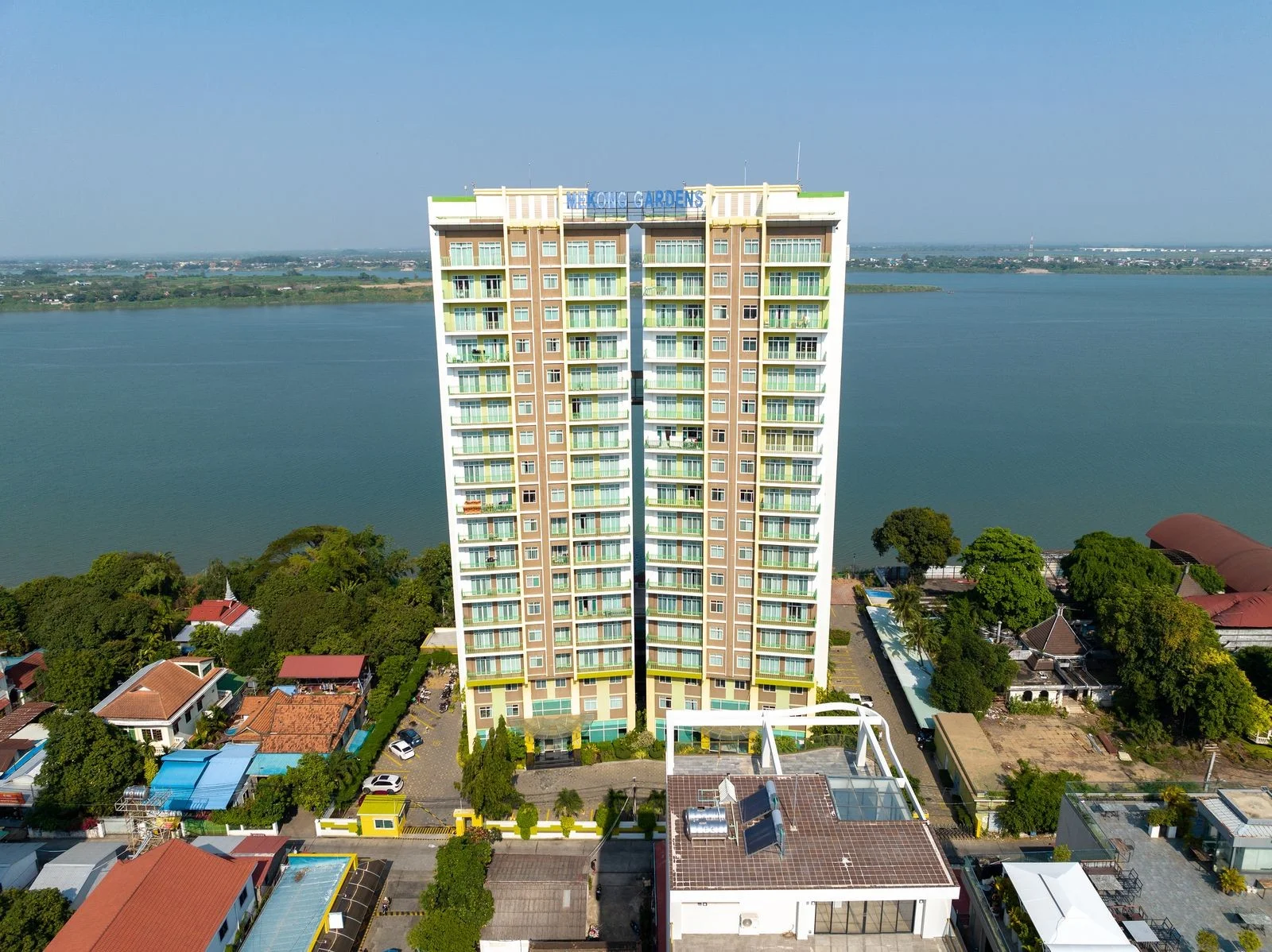
Quick answer: Chroy Changvar is a peninsula with one way in. Two bridges sit side by side at the same crossing point, and the distance from that point explains the district’s discount to the $1,800 per sqm city average, the tenants it attracts and the yield it produces. Underwrite the crossing and you have underwritten the district.
Chroy Changvar is not a neighbourhood that happens to be across a river. It is a spit of land between the Tonle Sap and the Mekong, and the only practical way onto it from central Phnom Penh is a pair of bridges standing side by side at the same point. Every projection about this district (rent, resale, tenant quality, appreciation) runs through that crossing.
The crossing, and the natural experiment that tested it
Two structures span the water at the peninsula’s neck. The older is the 709-metre Chroy Changvar Bridge, built with Japanese assistance between 1963 and 1966 as the first modern bridge over the Tonle Sap in Phnom Penh, destroyed during the civil war in 1972 and again in 1973, rebuilt with Japanese aid and reopened in 1994. Alongside it stands the Cambodian-Chinese Friendship Bridge, completed in 2015 on a Chinese loan and known locally as Chroy Changvar Bridge II.
Two bridges sound like redundancy. In practice they are one crossing with two carriageways, and the district found out what that means when the older bridge closed for more than a year of renovation and reopened in 2019 at a cost of about $30 million. For that period the peninsula’s entire access ran through a single structure. Residents who lived through it can tell you what the queue did to a morning commute, and agents who were letting units then can tell you what it did to asking rents.
That episode is more useful than any forecast. It is a documented test of the district’s single dependency, and it is the reason a buyer here should ask about traffic before asking about finishes.
The mainland district on the far side of the crossing is covered in Daun Penh; the alternative river-island model is in Koh Pich.
What distance from the bridge does to price
Peninsula pricing is close to linear in travel time. The stock nearest the crossing prices against the mainland; the stock at the far end prices against the outer suburbs, even though both sit on the same riverbank with similar views.
| Position on the peninsula | Indicative price per sqm | What the buyer is paying for |
|---|---|---|
| Adjacent to the crossing | $1,800 to $2,200 | Mainland-equivalent commute |
| Mid-peninsula, new build | $1,400 to $1,800 | River frontage, longer run to the bridge |
| Mid-peninsula, resale | $1,200 to $1,600 | Older fit-out, same access constraint |
| Far end | $1,000 to $1,400 | Space and quiet, weakest tenant reach |
| Phnom Penh average, all districts | About $1,800 | The benchmark all of the above discount from |
A one-bedroom of 50 to 55 square metres in new stock runs roughly $70,000 to $110,000, against $70,000 to $95,000 for the city as a whole; the same unit in older resale stock trades at $50,000 to $80,000. Read those two lines together and the district’s character becomes clear: new supply near the bridge asks a premium to the city, while everything else discounts to it.
City-wide pricing is set out in how much a Phnom Penh condo costs, and district-by-district comparison in the district yield comparison.
How much weight the yield figure will bear
Chroy Changvar has a widely repeated yield range, and it deserves to be handled carefully rather than repeated.
| Claim | Figure | Where it comes from | How much to trust it |
|---|---|---|---|
| District gross yield | 4.9% to 6.75%, average near 5.83% | One regional property portal, 2026 | Directional only, single unverified source |
| Affordable segment | 7% to 9% gross | Same portal | Same caveat, plus a thinner sample |
| Emerging-district ceiling | Up to 8.2% gross | A second portal, naming Chroy Changvar and Prek Pnov | Asking-side, not transacted |
| Phnom Penh gross range | 5.22% to 7.4% | Global Property Guide, Q1 2026 | Broadest sample, still listing-derived |
The average of 5.83% has a decimal place, which reads as precision and is not. It is one portal’s arithmetic over one set of listings, none of which are transaction records. What it is genuinely good for is ranking: it places Chroy Changvar mid-table among Phnom Penh districts, above the prime core on gross and below the cheapest suburbs, which matches what the rent bands below imply independently. What it is not good for is a spreadsheet cell.
Run the district on its own rents instead. A $70,000 one-bedroom letting at $450 a month grosses 7.7%. Deduct two to three months of vacancy (realistic here, given the tenant pool) plus a service charge near $1.50 per sqm per month and whatever your manager charges, and the net lands between 3.5% and 5%. On a rent this size the management structure is worth negotiating: a percentage of collected rent and a flat monthly fee produce very different numbers at $450, and the flat fee is usually the cheaper of the two. That is a defensible number built from lines you can verify, and it is the one to take to a decision.
Yield methodology is worked through in net versus gross yield and the vacancy assumptions in condo occupancy rates.
Who actually lives on the north bank
The peninsula’s tenant mix is unusual for Phnom Penh: it has almost no corporate demand and a great deal of value-seeking demand.
| Tenant | Monthly rent | Why they are here |
|---|---|---|
| Khmer middle-class households | $400 to $700 | Space and river outlook at a mainland discount |
| Logistics and industrial staff | $300 to $600 | Road access north and east without entering the city |
| Budget-conscious expatriates | $500 to $900 | A larger unit than the same money buys in BKK1 |
| Students and shared occupancy | $250 to $450 | The lowest rents within reach of the centre |
None of these 4 groups pays a premium for prestige, and none of them is captive. A logistics manager compares Chroy Changvar with Sen Sok and takes whichever is closer to work. A family compares it with Chbar Ampov and takes whichever crossing is quieter. That substitutability is why rent growth here tracks the city rather than leading it, and why a landlord’s pricing power is limited to what the commute is worth on the day.
Comparable suburban demand is described in Sen Sok and the southern equivalent in Chbar Ampov.
Buying on the peninsula? We will time the crossing at rush hour from the specific building you are considering, price the unit against comparable mainland stock, and model the vacancy the tenant mix actually implies.
Get the peninsula checkAdvantages and disadvantages of a peninsula position
The advantages are real and they are mostly about space. Land on the peninsula was cheap when the current stock was planned, so units are larger for the money, plots are wider, and river frontage is available at prices the mainland riverside cannot approach. Ownership is entirely ordinary: an apartment above the ground floor, held within the national ceiling of 70% of a building’s private-unit area, on the same registration route and the same 4% transfer tax as the mainland.
The disadvantages concentrate in one place. A peninsula cannot route around congestion, and the district has no second access point to relieve the one it has. That shows up as a wider vacancy allowance than the mainland requires, a shallower resale pool because buyers self-select for the commute, and a rent ceiling set by what tenants will tolerate rather than by what the building offers. Amenity is also thinner than tower marketing suggests: retail density on the peninsula is well below the central districts, so a resident’s daily errands frequently involve the bridge as well.
What would actually change this district
Most infrastructure talk here is about things that do not relieve the constraint of a single crossing carrying 100% of the peninsula’s traffic. Road resurfacing within the peninsula improves internal movement. Riverfront promenades improve the view. New towers add supply. None of them adds a way off the peninsula.
The one change that would reprice Chroy Changvar is a second crossing landing at a different point: something that turns a single-access peninsula into a through route. Proposals of this kind circulate periodically. As of this update, nothing of the sort is funded with a construction date, and a buyer who pays today for a bridge with no start date is buying an option with no expiry and no strike price. Price the district as it is, and treat any future crossing as upside you did not pay for.
For contrast, a district whose infrastructure question is already answered is covered in the Techo airport corridor.
Buying here: what to verify before you commit
Time the crossing yourself, in both directions, at 7:45am and 5:45pm on a weekday, starting from the actual building rather than from the sales office. Establish how much of the 70% ceiling the building has used, by area rather than by unit count, and take that in writing. Check the co-owners association’s accounts and the sinking fund balance, because peninsula buildings carry the same fixed costs on thinner rental income. Confirm the title type and the registration route, and budget the 4% transfer tax on the assessed value the tax administration sets rather than on your contract price.
If the unit is off-plan, the developer questions matter more here than the district questions: the 8.9% banking sector non-performing loan ratio is the backdrop against which completion risk is priced, and Prakas 047 requires a developer deposit of 2% of construction cost lodged with the regulator. Ask whether it was lodged. The duty and tax calendar is national and is covered in Cambodia property taxes and fees.
Ownership mechanics are set out in foreign ownership and strata title, and the transaction sequence in the due diligence process.
Frequently Asked Questions
On the peninsula north of central Phnom Penh, between the Tonle Sap and the Mekong, reached by two parallel bridges at a single crossing point: the 709-metre Cambodia-Japan Friendship Bridge of 1966 and the Cambodian-Chinese Friendship Bridge added alongside it in 2015.
It is the only practical way in and out. A peninsula has no alternative routes, so the queue at the crossing sets the commute, the commute sets the tenant pool, and the tenant pool sets the rent. Price falls with distance from the bridge in a way it does not on the mainland.
Portal comparisons put the district at 4.9% to 6.75% gross with an average near 5.83%, and 7% to 9% in the cheapest segment. That is one unverified portal source, so treat it as directional. Building the number from the district's own rents lands nearer 3.5% to 5% net.
Yes. New supply runs $1,400 to $2,200 per sqm and resale $1,000 to $1,600, against a Phnom Penh average of $1,800 per sqm. The discount is compensation for the crossing rather than for build quality.
Yes, on the ordinary basis: strata title above the ground floor, inside the cap of 70% of a building's total private-unit area. Nothing about the peninsula changes the ownership rules.
A second crossing landing at a different point. New towers, retail and promenades all work within the same access constraint. Nothing of the kind is currently funded with a construction date, so treat it as upside you have not paid for.
Get a Cambodia property shortlist
Share your budget, target district (BKK1, Koh Pich, Koh Norea, Siem Reap), and goal. We reply within one business day with matched stock and next steps.