Koh Pich Diamond Island: A District in Private Ownership
Roads, drainage and rules on Koh Pich belong to a developer, not a municipality. Every other question about the island runs through that.
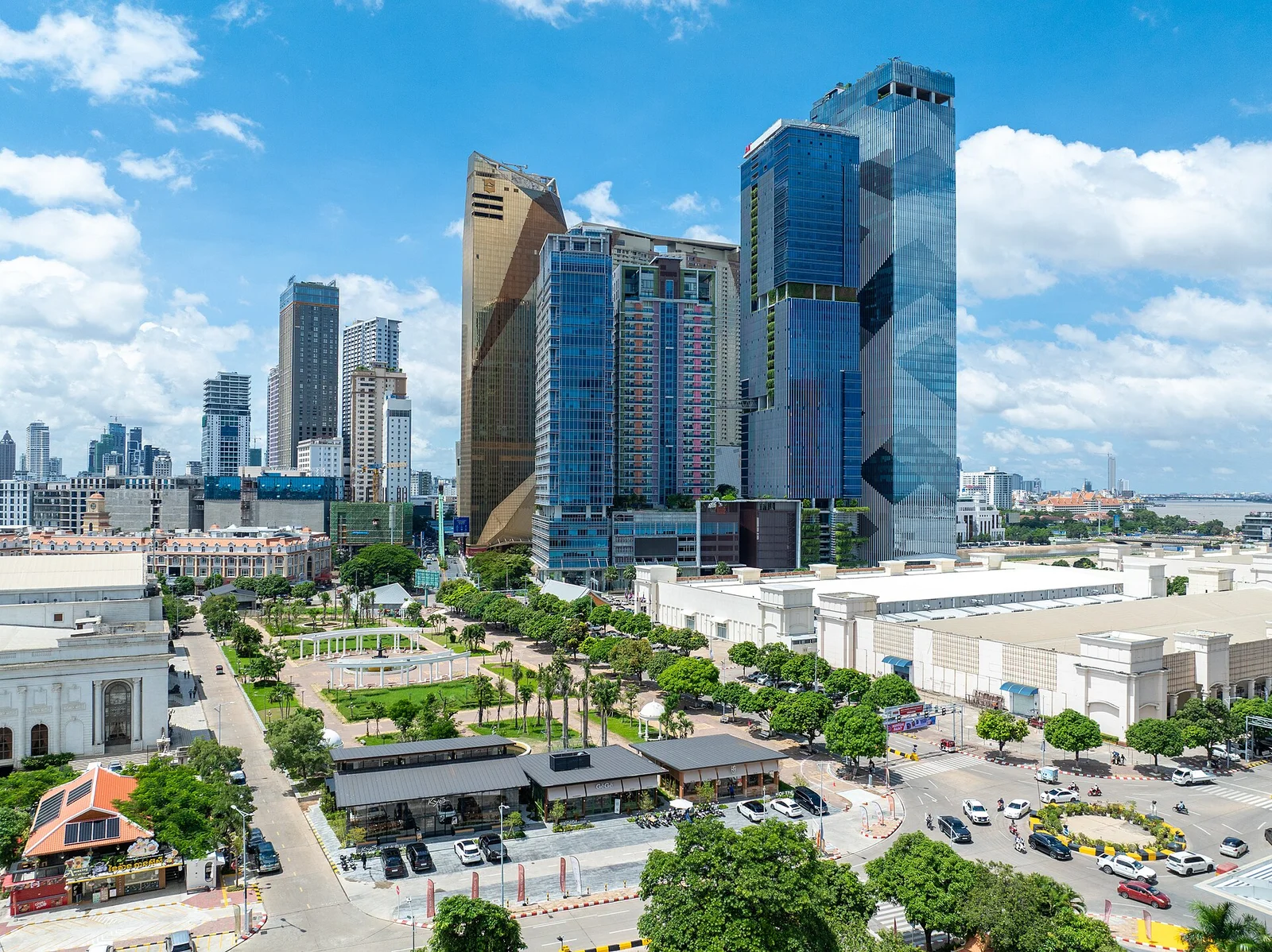

Quick answer: Koh Pich is Phnom Penh’s premium reclaimed island, master-planned by OCIC into a mixed-use district of towers, convention space, schools and retail. Foreign entry to island premium stock starts near $106,000, well above the $1,800 per sqm city average. The fact that governs everything else is that the district’s infrastructure is privately owned.
Every guide to Koh Pich lists the amenities. The amenities are the visible half of a single underlying fact: this district was built as a private estate and is run as one, and that arrangement explains the standards, the prices and the bills alike.
What does privately owned infrastructure mean in practice?
On the mainland, roads, drainage, street lighting and public order are municipal functions funded by general taxation. On Koh Pich all 6 of the lines below sit with the estate instead, and the island has run that way since reclamation began in the early 2000s.
| Function | Mainland Phnom Penh | Koh Pich |
|---|---|---|
| Roads and paving | Municipal | Estate-maintained |
| Drainage and flood management | Municipal | Estate-maintained |
| Street lighting | Municipal | Estate-maintained |
| Landscaping and public realm | Patchy, municipal | Managed to a standard |
| Security and access | Public policing | Estate security in addition |
| Who pays | General taxation | Property owners on the island |
That arrangement is the reason Koh Pich looks and functions the way it does, and the visible quality is something you buy rather than something you receive. Consistent paving, working drainage, planted verges and a coherent street layout are unusual in Phnom Penh precisely because they are expensive, and here they are paid for by the people who live and invest on the island. A buyer comparing an island apartment with a mainland one at the same price per square metre is comparing two different products: one includes a share of a functioning district, the other does not. That is a fair trade at the right price, and it is a poor one if the estate obligations were never disclosed.
The island’s master developer is profiled in the OCIC developer guide; the newer island being built to the same model is covered in Koh Norea.
The question to put in writing before you buy
Estate-level obligations are documented, but they live in the co-ownership papers rather than in the price list, and they are the line buyers skip.
| Ask for | Why |
|---|---|
| Estate infrastructure charge | Whether one exists and how it is calculated |
| Who owns the roads and drainage | Determines who repairs and who bills |
| Condominium service charge | The building-level cost, separately |
| What each charge covers | Routinely conflated in conversation |
| Historic increases | Private infrastructure ages and costs rise |
| The instrument that sets it | A contract or the co-ownership regulations |
Ask specifically whether the estate charge and the building service charge are two separate bills, because on an island district they are, and a quoted figure of about $1.50 per sqm per month is the building alone: the estate layer sits on top and nobody volunteers it. This is where island purchases disappoint on paper rather than in reality. The infrastructure is genuinely good, the standards are genuinely maintained, and the cost of both is genuinely borne by owners. A buyer who models only the condominium charge has understated their annual outgoing by a margin that compounds over a decade, and has done so using a number an agent gave them accurately in answer to the wrong question.
The building-level cost framework is in the sinking fund and fees guide; pricing a specific island unit is covered in the resale valuation guide.
Which developer is actually selling to you?
OCIC master-planned the island, but not every tower on it is an OCIC building. There are at least 2 counterparties behind any island purchase, and the distinction has consequences a buyer should establish before signing.
| Counterparty | What they control |
|---|---|
| Master developer | Estate rules, infrastructure, the plan’s future phases |
| Plot developer | Your building, its specification and its warranty |
| Where they overlap | Amenity promises made at the estate level |
| Where they diverge | Who answers when something is not delivered |
| The buyer’s question | Which entity is on my sale agreement |
| The risk | An amenity sold by one, deliverable only by the other |
The island’s documented schemes include buildings from several developers, and the estate framework governs all of them. The practical consequence is that a promise made in a plot developer’s showroom about island-level amenity, a promenade, a school, a marina, a future phase, is a promise about something that developer does not own. That does not make it false, but it does make it unenforceable against the person who made it. A buyer should separate what their own sale agreement obliges from what the master plan illustrates, and treat only the first as contractual.
The buildings this site reviews on the island include D.I. Riviera, the earliest condominium here, and Diamond Bay Garden, a recent completion.
Considering Koh Pich? We will establish which developer is actually your counterparty, obtain the estate and building charges separately, and tell you what the island layer adds to your annual cost.
Get both charges in writingWhat the island’s pricing reflects
Koh Pich sits at the top of the Phnom Penh market alongside BKK1, and it gets there by a different route.
| Market | Position |
|---|---|
| Koh Pich premium stock | Foreign entry from about $106,000 |
| Trading level | Well above the ~$1,800 per sqm city average |
| BKK1 | $2,800-$3,500 per sqm |
| Tonle Bassac | $2,200-$3,200 per sqm |
| What Koh Pich sells | Planned environment and amenity |
| What BKK1 sells | Location and tenant depth |
The two premium districts deserve to be separated sharply, because buyers treat them as interchangeable at the top of a budget. BKK1’s premium rests on proximity to a specific cluster of embassies, offices and restaurants, and its tenant pool is the deepest in the country. Koh Pich’s rests on the estate itself, the environment, the amenity, the coherence, and its tenant is choosing a lifestyle rather than minimising a commute. That makes island demand end-user-driven rather than employer-driven: more durable in one direction and thinner in the other. An investor letting to corporate tenants finds BKK1 easier; an owner-occupier who values a walkable, planned district prefers the island. Both are right about their own case.
The comparison district is documented in BKK1 and the corridor between them in Tonle Bassac.
Who does the island suit?
An owner-occupier who wants a planned, walkable environment and will use the amenity daily gets the island’s full value at an entry near $106,000, and needs only to verify the 2 charges. A long-hold investor buying end-user quality is well served, provided the estate layer is in the yield model rather than discovered later. A yield-focused investor will find better arithmetic on the mainland one district out, because the island’s costs are real and its rents are not proportionally higher. And a buyer attracted by a future phase illustrated on a master plan should establish who is contractually obliged to build it before paying anything toward it.
Before you commit
Obtain the estate infrastructure charge and the building service charge as two separate written figures, with what each covers. Establish which developer is your counterparty on the sale agreement and which controls the estate. Ask who is responsible for drainage and flood management, and what the arrangement has cost historically. Get the title position beneath the strata plan. Request closed transfers from inside the specific building rather than island-wide asking prices. Obtain the quota extract in square metres. Nothing about the island changes the duty and tax calendar, which is common ground and covered in Cambodia property taxes and fees.
Two decades in, what the island has proved
Koh Pich is old enough to be judged on outcomes rather than intentions, which makes it unusually informative for anyone weighing a newer master plan elsewhere.
What worked is visible on any walk: the district was built out, the infrastructure functions, the retail and schools operate, and the streets are maintained to a standard the mainland rarely matches. A private estate model delivered a coherent piece of city, and that is not a small thing in a market where half-finished schemes are common enough to have their own guide on this site.
What took longer is equally instructive. Two decades is the timescale on which an island of this size fills, and the early owners carried years of thin amenity before the district became what it is now. That is the cost of buying at stage one, and it was real for the people who paid it. Anyone being shown a master plan for a newer island should hold both halves of that record in mind at once: the model does work, and it works slowly.
Frequently Asked Questions
The island's infrastructure was built and is maintained privately rather than municipally. Roads, drainage, lighting, landscaping and security are funded by the people who own property there, a materially different cost structure from a mainland address.
It adds a layer mainland buildings do not carry. Alongside the ordinary condominium service charge sits an estate-level infrastructure contribution, and that obligation lives in the co-ownership documents rather than the brochure.
Foreign entry to island premium stock starts from about $106,000 and trades well above the roughly $1,800 per sqm city average. It is a capital-quality district rather than an affordability one.
OCIC master-planned Koh Pich and remains dominant, though individual towers have been built by third-party developers on island plots. The master developer sets the estate rules; the plot developer sells you the apartment, and they are not always the same counterparty.
It is a question to ask rather than a reason to avoid an island built on and occupied for two decades. Establish the title status beneath the strata plan and who carries responsibility for drainage and flood management, since those are estate rather than municipal functions.
Koh Pich is what Koh Norea is trying to become, roughly twenty years further along. Here you pay for a district that already works; there you pay less for one that does not yet. The difference is stage, not model.
Get a Cambodia property shortlist
Share your budget, target district (BKK1, Koh Pich, Koh Norea, Siem Reap), and goal. We reply within one business day with matched stock and next steps.