Branded Residences in Cambodia: Premium, Yield and Risk
Branded schemes charge a 30% city premium worldwide. Whether Phnom Penh can return it, what the management contract costs and the clauses that decide.
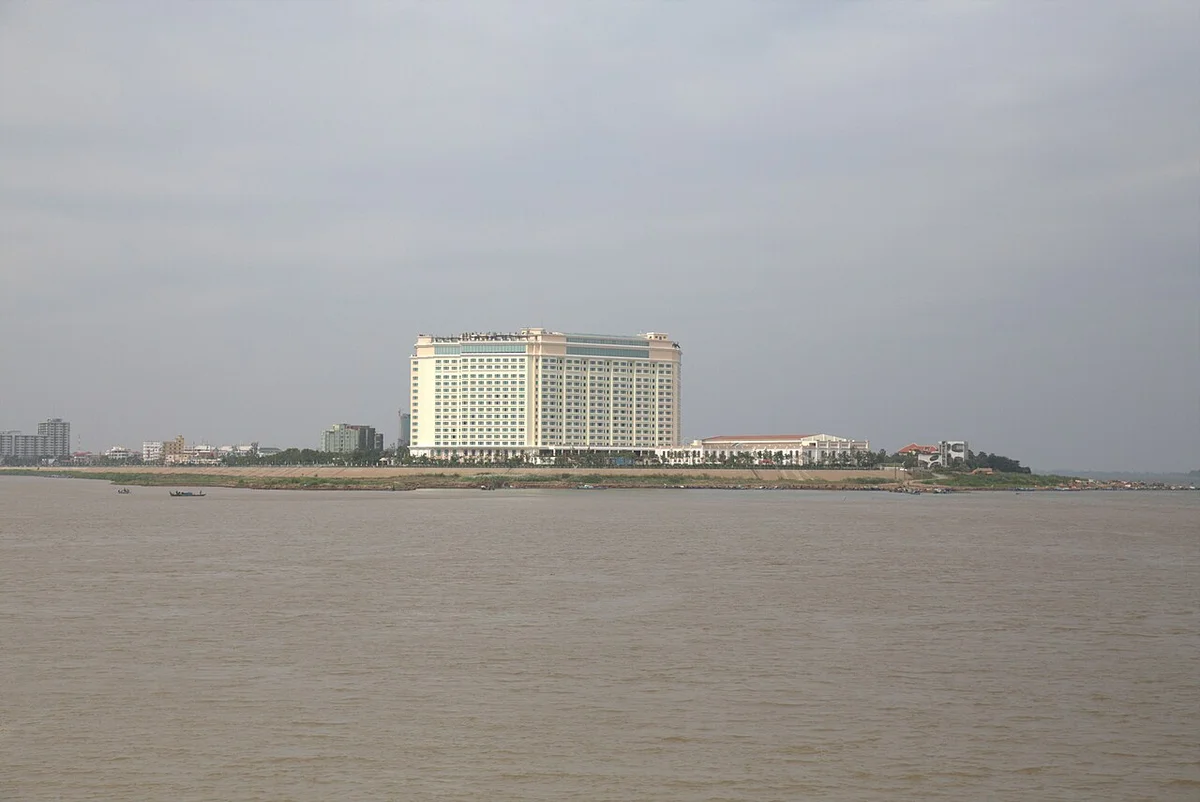
Quick answer: Branded residences charge a global average premium of 33%, about 30% in cities like Phnom Penh. The brand is real, the service is usually real, and the question for a Cambodian buyer is whether a market with a falling index and thin resale liquidity can give that premium back on exit.
Branded residences are the fastest-growing luxury property format in the world and the least tested in Cambodia. The global data is excellent, the local evidence is almost non-existent, and the gap between those two facts is where a foreign buyer either finds an advantage or overpays by six figures.
This page holds both sides. It takes the global premium data seriously, because it is well researched and consistent across cycles, and then applies it to a specific market with a residential index that fell 4.52% year on year in January 2026 and a resale market that is thin at any price point. What survives that test is a narrow but genuine case.
Scale is the reason the global data deserves attention rather than dismissal. Branded residences reached roughly 910 schemes worldwide by the end of 2025, growing 19% in a single year, and Asia Pacific expanded 55% across five years with 187 further projects forecast by 2032, a pipeline that would take regional supply up 97%. That is not a marketing category, it is a format with two decades of pricing history across multiple property cycles, and the 33% average premium it commands has been measured repeatedly rather than asserted once. Our analysis accepts the global finding and separates it cleanly from the local question, which is whether a market as thin as Phnom Penh’s resale market can express that premium at all.
What is a branded residence and what does the brand supply?
A branded residence is a residential unit sold with a hotel or luxury brand attached under a licensing or management agreement, and the format has grown to roughly 910 schemes worldwide by the end of 2025, up 19% year on year. The buyer owns the unit; the brand supplies name, standards and usually management, for fees and a fixed term.
| What the brand supplies | What it does not supply |
|---|---|
| The name and its recognition | A guarantee of resale value |
| Service standards and staff training | Ownership of the building or the units |
| Usually the management company | Permanence; agreements have terms |
| A rental programme in many schemes | A guaranteed occupancy or return |
| Design and specification control | Protection from a falling market index |
| Access to hotel amenities where co-located | Any change to Cambodian ownership law |
The distinction in the second column is where our analysis spends most of its time on a branded scheme. A brand is a contract with a term, a fee and termination provisions, and a buyer paying a 30% premium is buying the expected value of that contract over the holding period. Reading it is not optional, and in Phnom Penh it is frequently not offered until a deposit has been taken.
- Licensing agreements give the name; management agreements give the operation.
- Terms commonly run 10 to 25 years with renewal and termination rights.
- Fees are charged to the building, the owner, or both, and vary widely.
- Rental programmes are optional in some schemes and mandatory in others.
- Standard strata rules still apply, per the foreign ownership guide.
What premium do branded residences command?
Branded residences command a 33% average price premium globally according to Savills, rising to 39% in resort locations and settling near 30% in established and emerging cities. Phnom Penh falls into the city category, which makes roughly 30% the benchmark a buyer should test any local branded asking price against.
| Segment | Average premium | Relevance to Phnom Penh |
|---|---|---|
| Global average, all locations | 33% | Directional only |
| Resort locations | 39% | Applies to coastal schemes, not the capital |
| Established cities | About 30% | The closest comparable category |
| Emerging cities | About 30% | Phnom Penh’s category |
| Phnom Penh prime unbranded benchmark | $2,300 to $3,200 per sqm | The base the premium applies to |
| Implied branded price per sqm | $2,990 to $4,160 | Test any asking price against this |
That last row is the most useful line on this page. A branded unit in a Phnom Penh prime district asking materially above $4,160 per sqm is charging a resort premium in a city market, and our analysis treats anything beyond the implied band as a pricing question the developer needs to answer with comparables rather than with brand collateral.
- Apply the city premium, not the global average, to a capital-city scheme.
- The base for the calculation is the unbranded comparable in the same district.
- Prime district pricing detail sits in the condo price guide.
- A premium above 40% in a city scheme needs specific justification.
- Savills figures are global research, not Cambodian transaction evidence.
Does the premium survive in the Phnom Penh market?
The branded premium is well evidenced globally and unproven in Cambodia. Phnom Penh’s residential index fell 4.52% year on year in January 2026 on a ninth consecutive month of decline, resale liquidity is thin across all price points, and there is almost no branded resale history to test the premium against locally.
| Test | Global evidence | Phnom Penh evidence |
|---|---|---|
| Entry premium | 33% average, about 30% in cities | Asking prices consistent with it |
| Resale premium retention | Documented across cycles | Almost no completed resales |
| Rental premium | Real, in serviced schemes | Plausible, unquantified locally |
| Liquidity advantage | Branded stock sells faster globally | Untested in a thin market |
| Market direction during the hold | Varies by city | Index falling for nine consecutive months |
Reconciling those columns honestly produces a conditional answer rather than a verdict. Global research consistently shows branded stock resells at a premium and sells faster, and there is no obvious reason Cambodia would be the exception once a resale market exists. There is equally no local evidence that it already does, and our underwriting will not treat an unproven premium as an asset. That is why we price a Phnom Penh branded unit on its rental economics and its unbranded comparable, and treat any resale premium as upside rather than as a return assumption.
- Global premium data is strong, and it is not Cambodian data.
- Nine consecutive months of index decline is the market a buyer is entering.
- Resale liquidity generally is covered in the resale liquidity guide.
- Asia Pacific branded supply is growing 55% over five years, adding future comparables.
- A premium that cannot be evidenced locally should not be underwritten as recoverable.
Insider tip: ask the developer for the operator’s signed agreement and check three things in it: the term, the termination rights and who pays the brand fee. In Phnom Penh a surprising number of towers marketed as branded hold a licensing arrangement with a term shorter than the buyer’s intended hold, and one of them is currently marketed as five-star managed on the strength of a letter of intent.
Send the tower, the operator name, the price per sqm and the branding agreement. We test the premium against unbranded comparables and read the termination and fee clauses.
Review a branded schemeWhat do the branding and management contracts cost an owner?
Branded schemes cost an owner more every year than unbranded stock: a higher service charge against the roughly $1.50 per sqm per month typical of Phnom Penh buildings, plus a management or licensing fee that is commonly a share of rental revenue. On a 100 sqm unit the annual difference runs into thousands of dollars.
| Cost line | Unbranded Phnom Penh condo | Branded scheme |
|---|---|---|
| Service charge per sqm per month | About $1.50 | Commonly $2.50 to $4.00 |
| Annual service charge, 100 sqm unit | About $1,800 | $3,000 to $4,800 |
| Rental management fee | 8% to 12% of collected rent | 20% to 35% in a branded programme |
| Brand or licensing fee | None | Charged to the building or the owner |
| Sinking fund contribution | Standard | Higher, to protect brand standards |
| Refurbishment cycle | Owner’s discretion | Mandated to brand standard |
The mandated refurbishment line is the one buyers discover late. Brand standards require units in a rental programme to be maintained and periodically refitted to specification, at the owner’s cost and on the operator’s timetable rather than the owner’s. That is a genuine benefit for asset quality and a genuine cost for cash flow, and our underwriting models it as a recurring capital line rather than as an occasional surprise.
- Service charge mechanics are covered in the sinking fund guide.
- A 20% to 35% management share is normal in branded rental programmes.
- Compare the net to an unbranded unit, not the gross rent to the gross rent.
- Refurbishment to brand standard is mandatory, not discretionary.
- Any guaranteed return attached to a programme deserves the rent guarantee warning.
What happens when a brand exits a scheme?
When a brand exits, the premium exits with it. The building becomes an unbranded tower carrying branded-level service charges, resale value benchmarks against unbranded comparables in the same district at $2,300 to $3,200 per sqm, and the owner who paid a 30% premium on entry absorbs the difference.
| Consequence of a brand exit | Effect on the owner |
|---|---|
| Loss of the name | Resale benchmarks reset to unbranded comparables |
| Loss of the operator | Management reverts to a local company or the owners |
| Service charges | Frequently stay high; standards and staffing are sticky |
| Rental programme | Ends or is replaced on worse terms |
| Marketing position | The tower competes on specification alone |
| The 30% entry premium | Not recoverable through the brand |
Termination rights are therefore the most valuable clauses in the whole transaction, and they are rarely read by buyers. An operator that can exit on twelve months’ notice for performance reasons has sold the buyer an option rather than a permanent attribute, and our analysis treats a short or freely terminable agreement as reason to price the unit as unbranded stock from the outset. On a 100 sqm unit bought at $3,900 per sqm against an unbranded comparable of $3,000, that repricing is $90,000, which is the entire premium and roughly three years of gross rent on the same unit. This is not a reason to avoid branded schemes, and it is a red flag worth acting on: read the agreement before paying the premium rather than after, because the clause costs nothing to check and the premium is not refundable.
- Ask for the agreement term and the earliest termination date.
- Establish whether owners have any say in a replacement operator.
- Check whether the brand can exit for developer non-performance.
- Confirm what happens to the rental programme on termination.
- Price the unit as unbranded if the agreement can end inside your hold.
Which buyer does a branded residence suit?
A branded residence suits a buyer who values the service and the certainty of standards for their own use, and suits a pure yield investor poorly. Our analysis is that the 30% premium is best justified by occupation and convenience rather than by an expected resale gain that Phnom Penh has not yet demonstrated.
| Buyer profile | Fit | Reasoning |
|---|---|---|
| Owner-occupier wanting hotel-standard service | Strong | The premium buys something used daily |
| Part-year resident splitting time | Strong | Managed absence is the format’s core benefit |
| Yield investor comparing net returns | Weak | Higher charges and fees compress the net |
| Investor betting on premium retention at resale | Speculative | No local resale evidence exists yet |
| Buyer wanting service without the premium | Redirect | A serviced apartment delivers most of the benefit |
The redirect row matters because it is the cheapest answer for a large share of enquiries. A serviced apartment in a well-managed prime building delivers housekeeping, reception, utilities and maintenance without a brand licence attached to the price, and it is priced against unbranded comparables rather than against a 30% premium. The full comparison sits in the serviced apartments guide.
Advantages and disadvantages of branded stock in Cambodia
Branded residences offer the highest specification and the most reliable management standard available in Phnom Penh, at a premium the local market has not yet been shown to return. The trade is between quality of ownership experience and quality of investment evidence.
| Advantage | Disadvantage |
|---|---|
| Global research shows 33% average premium retention | No Cambodian resale evidence to test it locally |
| Management standards are contractual, not aspirational | Service charges commonly double unbranded levels |
| Strong appeal to a specific expat and part-year buyer | Rental programme fees of 20% to 35% compress net yield |
| Asia Pacific supply up 55% in five years builds comparables | Brand exit removes the premium entirely |
| Design and specification control protects the asset | Mandated refurbishment on the operator’s timetable |
| Standard strata rules apply, so foreign freehold is intact | Entering a market with the index down 4.52% year on year |
The strongest genuine argument for branded stock in Phnom Penh is management quality rather than price, and it deserves to be made properly because the premium debate obscures it. Building management is the most consistent complaint in the Cambodian condo market: sinking funds that are not collected, service standards that drift within three years of handover, and managers appointed by developers with no incentive to maintain the asset. A contractual brand standard, enforced by an operator with a name to protect, addresses precisely that failure. Our analysis is that a buyer who values that protection is buying something real, and a buyer who expects a 30% resale premium to be waiting in a market with nine consecutive months of index decline is buying a hypothesis. On a $400,000 unit the difference between those two positions is $120,000 of entry price.
Buyer scenarios and red flags
Three scenarios cover most branded enquiries, and the red flags repeat: a brand claimed without a signed agreement, a premium above the city benchmark, and a rental programme presented with a return attached.
| Scenario | What they want | What we would recommend |
|---|---|---|
| $400,000, part-year resident | A branded unit for personal use | Good fit; verify the agreement term first |
| $400,000, pure yield investor | The branded rental programme | Unbranded prime unit, better net |
| $900,000, wants prestige and resale | The most premium scheme available | Buy on rental economics; treat premium as upside |
The failure pattern in branded property is a premium paid for a brand that has not signed. A buyer is shown renderings carrying an international hotel name, is told the operator agreement is in final negotiation, and pays $3,900 per sqm against an unbranded district comparable of $3,000. The tower completes two years later under local management, because the agreement was never concluded or was terminated during construction, and the unit is now benchmarked at $3,000 per sqm with service charges set for a five-star operation. The buyer is down roughly $90,000 on a 100 sqm unit before any market movement is counted. Our underwriting requires a signed and disclosed operator agreement before treating a scheme as branded, and treats a letter of intent as marketing rather than as a contract.
- Require the signed operator agreement, not a letter of intent.
- Test the asking price against the $2,990 to $4,160 per sqm implied band.
- Read the term and the termination rights before paying any premium.
- Check whether the rental programme is optional or mandatory.
- Valuation on exit follows the resale valuation guide.
Prime district context sits in the BKK1 area page and the Tonle Bassac area page, and the full asset-class map is in the commercial property pillar.
Tell us whether the unit is for your own use or purely for yield. That answer decides whether the premium is worth paying, and we will price both cases.
Talk to our Cambodia deskFrequently Asked Questions
A residential unit sold with a hotel or luxury brand attached under a licensing or management agreement. The buyer owns the unit; the brand supplies name, standards and usually management for a term.
Savills puts the global average at 33%, 39% in resorts and about 30% in established and emerging cities. Phnom Penh sits in the city category.
A small number of Phnom Penh towers combine luxury residential floors with hotel management, and more are marketed as branded than hold a signed operator agreement.
Unproven locally. Global research supports premium retention, but Phnom Penh has a falling index, thin resale liquidity and almost no branded resale evidence.
Service charges commonly $2.50 to $4.00 per sqm per month against about $1.50 unbranded, plus rental programme fees of 20% to 35% of collected rent.
The premium leaves with it. The tower is benchmarked against unbranded comparables while service charges usually stay high.
Send the tower, operator name, price per sqm and the branding agreement. We test the premium against unbranded comparables and read the termination and fee clauses.
Get a Cambodia property shortlist
Share your budget, target district (BKK1, Koh Pich, Koh Norea, Siem Reap), and goal. We reply within one business day with matched stock and next steps.