BKK3 Phnom Penh: The Volume Tier Next Door to BKK1
BKK3 shares a boundary with BKK1 and prices a fifth below it. That gap is a product discount, not a location one, and it decides how the exit works.
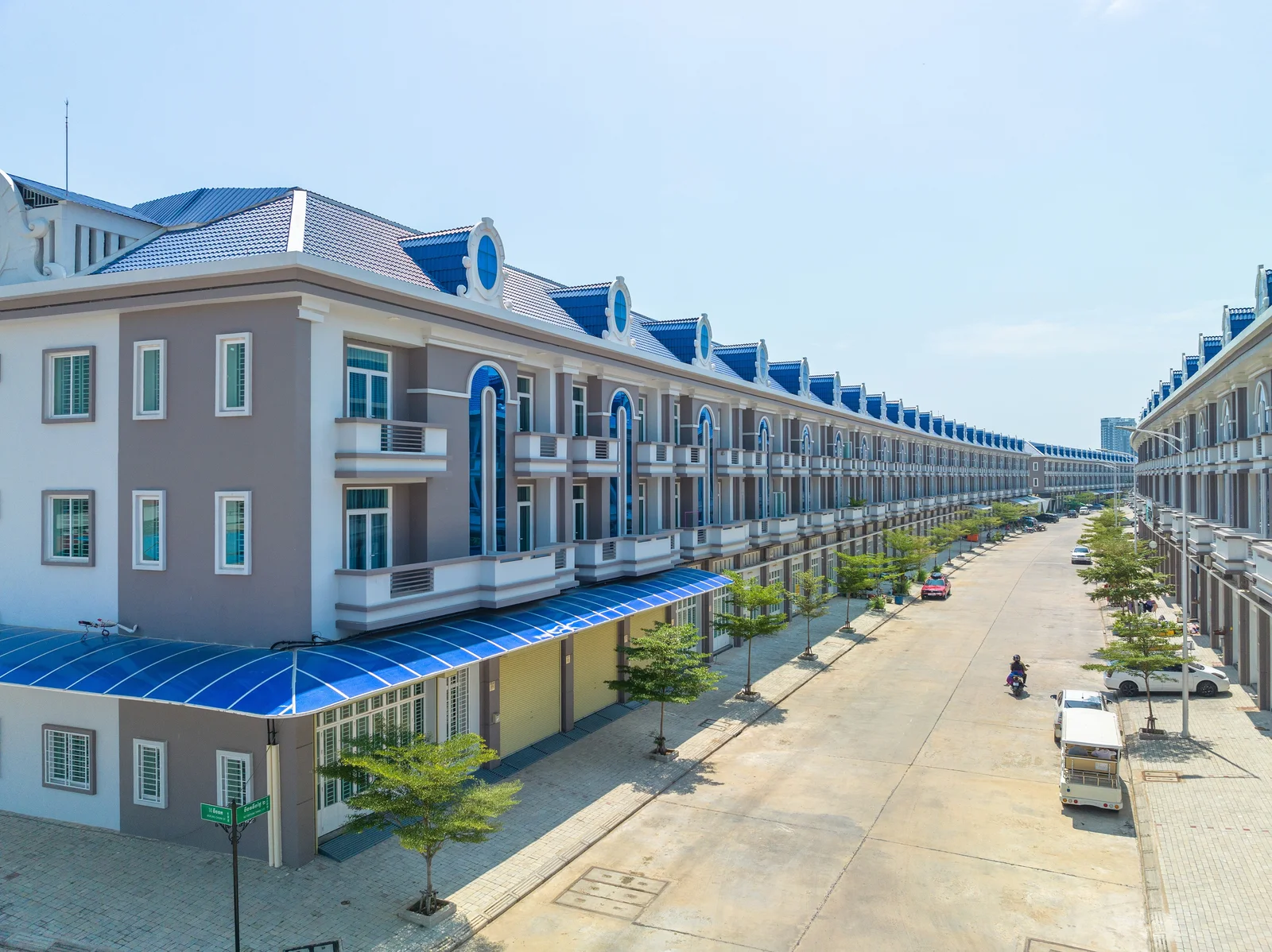
Quick answer: BKK3 shares a boundary with BKK1 and prices about a fifth below it, at $1,400 to $1,900 per square metre. The gap is not distance: it is product. BKK3 is where Phnom Penh’s volume tier was built, and volume is both what you are buying and what you will be selling against.
Boeung Keng Kang 3 is not a suburb of BKK1. The two are adjacent, and a tenant can walk between them in minutes. Yet the price difference is around a fifth, and understanding why is the entire BKK3 investment case.
One boundary away, and a fifth cheaper
| Metric | BKK3 | BKK1 | City average |
|---|---|---|---|
| Price per sqm | $1,400 to $1,900 | $2,200 to $2,800 | About $1,800 |
| Studio entry | $38,000 to $55,000 | Rare in the core | $40,000 to $60,000 |
| One-bedroom entry | $55,000 to $90,000 | $110,000 to $150,000 | $70,000 to $95,000 |
| Modelled gross yield | 6% to 8.5% | 5% to 7% | 5% to 7% |
| Tenant profile | Younger, price-led | Embassy and corporate | Mixed |
| Development land | Available, and used | Almost none left | Varies |
Those yield figures are computed from the two rows above them rather than borrowed: a one-bedroom bought at the $70,000 midpoint and let at $500 a month grosses 8.5%, while the same unit at $90,000 and $450 grosses 6%. The development-land row explains the rest. BKK1 ran out of sites while it was still the address people wanted, so its stock is constrained, its buildings are mostly older and lower, and its rents are supported by tenants who will pay for the location. BKK3 had land when the condominium boom arrived, so it received the towers: taller, denser, with smaller floorplates aimed at a price point rather than at a lifestyle.
That is why the discount is stable rather than a mispricing waiting to correct. A buyer expecting BKK3 to converge on BKK1 is expecting a district full of volume product to be revalued as scarce product, on the same street where the scarce product already exists.
The head-to-head is worked through in BKK1 versus BKK3, and the prime district itself in BKK1.
What happens when one developer supplies a district
Several of BKK3’s towers come from a single group. Megakim World Corp’s Time Square series runs across Phnom Penh, with several projects in and around the district: Time Square 306, Time Square Ocean View, Square Castle, and Time Square 11, which launched in BKK3 on 4 March 2026 as a 39-storey building of roughly 390 units on an 828 square metre plot, with construction from September 2026 and completion targeted for June 2029.
Concentration of supply has two effects that pull in opposite directions, and both are real.
| Effect | How it helps | How it hurts |
|---|---|---|
| One developer, many towers | Consistent specification, familiar process | Similar units competing with each other |
| Continuous launches | Entry pricing stays accessible | New stock undercuts your resale |
| Standardised payment plans | Low barrier to entry | Many owners exit on the same timetable |
| Recognisable brand | Easier to let and to explain | Your unit is not differentiated |
The developer’s own record is examined in the Megakim profile, and two of the district’s buildings in Time Square 306 and Square Castle. Not every tall building in BKK3 is part of that series: Agile Sky Residence, a 45-storey tower by China’s Agile Group on Preah Monivong Boulevard, was completed in 2022 and competes for the same tenants from a finished building rather than a launch.
How does an advertised 11% yield survive contact with costs?
Headline yields of 11% appear in agency marketing for BKK3 off-plan stock. That claim can be checked without any private information, because the advertiser supplies the price.
Take a one-bedroom of 38 square metres advertised from about $49,616. An 11% gross yield on that price requires $5,458 a year, which is roughly $455 every month, collected without a single empty week and before a single cost.
| Step | Annual effect | Running figure |
|---|---|---|
| Gross rent at $455 a month, fully let | $5,458 | $5,458 |
| Citywide vacancy of about 15% | Minus $819 | $4,639 |
| Service charge near $1.50 per sqm on 38 sqm | Minus $684 | $3,955 |
| Resident rental tax at 10% of gross rent | Minus $464 | $3,491 |
| Net yield on the advertised price | About 7% |
Seven per cent is a good number. It is not eleven, it still excludes every management fee, and it assumes a unit completing in June 2029 lets immediately in 2029 at a rent quoted in 2026. A non-resident owner faces 14% withholding rather than 10%, which takes the same unit closer to 6.7%.
None of this makes the building a bad purchase. It makes the marketing number a gross figure with the costs removed, which is a different thing from a yield. Run the same arithmetic on any BKK3 launch before reserving.
Method and definitions are in net versus gross yield, and the tax lines in rental income tax for foreign owners.
Reserving in BKK3? We will rebuild the developer's yield from the advertised price, check the payment schedule against construction milestones, and show you what the handover balance looks like in cash.
Rebuild the numbersWhat the instalment plan actually commits you to
BKK3’s standard structure is 20% on signature and about 1% of the price a month, interest free, across roughly 30 to 40 months. On a 35-month plan that is 20% plus 35%, so 55% is paid by the time the schedule ends, with the remaining balance due at handover. Market convention puts that handover balance at 30% to 50% of the price.
Two things follow. The plan is genuinely accessible, and the balloon at the end is genuinely large: on a $50,000 unit, roughly $22,500 falls due in a single payment three years after reservation. A buyer who has not arranged that in advance is relying on a resale before completion, in a district where the developer will still be launching.
Ask whether the instalments track construction milestones or the calendar. A calendar-linked schedule pays a developer on time regardless of progress; a milestone-linked one is the buyer’s main protection, and it is negotiable at reservation rather than later.
Payment mechanics are set out in off-plan payment schedules and the failure cases in the delay and default guide.
Who rents in BKK3, and how often they leave
| Tenant | Monthly rent | Typical stay |
|---|---|---|
| Junior professionals | $350 to $600 | Six to twelve months |
| Regional expatriates | $450 to $800 | Twelve months |
| Remote workers | $400 to $700 | Three to twelve months |
| Students | $250 to $450 | Academic year |
| Small local households | $300 to $550 | Twelve months |
The rent bands are healthy relative to the entry price, which is where the district’s yield advantage comes from. The stay lengths are the offsetting fact. A tenant base of junior professionals, students and remote workers turns over considerably faster than an embassy household, and every turnover costs a void, a clean and often an agency fee.
That is why BKK3 rewards active management and punishes absentee ownership. The gross yield advantage over BKK1 is real, and it is the compensation for doing more work rather than a free lunch.
Advantages and disadvantages of buying the volume tier
The advantages are cash flow and access. Entry from around $40,000 puts a central Phnom Penh address inside a small budget, modelled gross yields of 6% to 8.5% are the highest in the central districts, the 20% deposit structure lowers the barrier further, and the location genuinely is next to the prime core rather than on the edge of the city.
The disadvantages are all versions of the same fact: there is a lot of it. Supply depth caps rent growth, since a tenant asked for more can move within the same district to a near-identical unit. Tenant churn is high and management-intensive. The handover balance is substantial. And resale competes against both the developer’s unsold inventory and hundreds of comparable units, which is the subject of the next section.
Why the exit is the hard part in a cluster district
In most markets a reseller competes with other resellers. In a cluster district they compete with the developer as well, and the developer has a show unit, a sales team, a payment plan and no deadline.
The practical consequence is that resale in BKK3 tends to clear at or slightly below current launch pricing rather than above it, for as long as new towers are being released. Absorption citywide runs at roughly 3% to 4% of stock a year against a pipeline of 76,000 to 80,000 units, so “for as long” is a period measured in years rather than quarters.
Differentiation is the only real defence: a corner unit, a genuinely better floor, an outlook that the next tower cannot build out, a fit-out standard the developer does not offer. Buy the unit that is not interchangeable, or accept that you will be a price-taker on the way out. One timing point does belong here: an owner planning to exit before the cluster is absorbed should read the duty and capital gains calendar in Cambodia property taxes and fees before fixing a date.
Exit conditions are covered in resale liquidity and the new-versus-resale trade in buying new or resale.
What to verify before you reserve
Ask what share of the 70% cap this tower has already sold, measured by area rather than by units, and get the answer dated and in writing: in a district of 39-storey buildings the ceiling binds sooner than buyers expect. Ask for the Prakas 047 developer deposit receipt, which is 2% of construction cost lodged with the regulator, and the regulator licence required above 30 units, against a banking sector carrying an 8.9% non-performing loan ratio. Establish whether the payment schedule follows milestones or the calendar, and what the contract gives you if completion slips.
Then count the competition. Walk the surrounding blocks and note how many towers of similar specification are under construction or selling, because that number is your future resale market and your rent ceiling at the same time.
Developer checks are set out in developer due diligence red flags.
Frequently Asked Questions
The discount is about product, not distance. BKK1 holds the embassy and corporate rental core and has almost no development land left; BKK3 absorbed the volume tier, where towers are taller, units smaller and supply deeper. You pay less for a different kind of building on the next street.
Roughly $1,400 to $1,900 per square metre against $2,200 to $2,800 in BKK1 and an $1,800 city average. Studios start around $38,000 to $55,000 and one-bedrooms around $55,000 to $90,000, with off-plan launch pricing occasionally below that.
No. On a unit advertised from about $49,616, an 11% gross yield needs roughly $455 a month with no vacancy, no service charge and no tax. Apply the city's 15% vacancy, a service charge near $1.50 per sqm per month and 10% resident rental tax, and the same rent produces about 7% before any management fee.
A series of condominium projects by Megakim World Corp across Phnom Penh, several in and around BKK3. Time Square 11 launched in BKK3 on 4 March 2026 as a 39-storey tower of roughly 390 units on an 828 square metre plot, with completion targeted for June 2029.
Exit. When one developer supplies several near-identical towers in one district, a reselling owner competes against the developer's unsold stock and hundreds of similar units, which caps resale pricing until the cluster is absorbed.
A cash-flow investor who will manage the unit actively, accepts higher tenant churn, and is buying the yield rather than the address. A buyer who wants scarcity or a premium tenant should pay the BKK1 price instead.
Get a Cambodia property shortlist
Share your budget, target district (BKK1, Koh Pich, Koh Norea, Siem Reap), and goal. We reply within one business day with matched stock and next steps.