Kep Property 2026: Seafront Villas, Shallow Liquidity
A $327,500 median and coastal land near $100 per sqm, in a province so small that comparable sales barely exist. Priced like a resort, traded like a village.
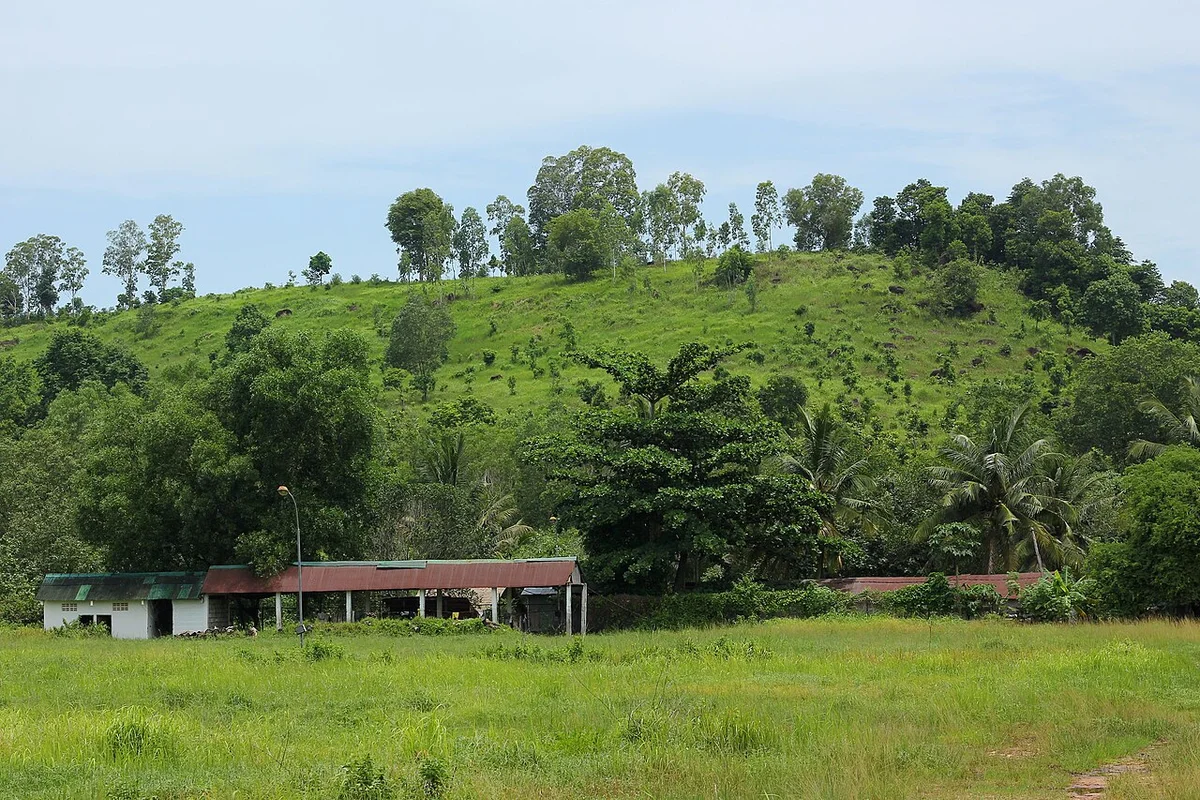
Quick answer: Kep is priced like a resort market and traded like a village. Residential stock runs $65,500 to $1,023,400 with a median near $327,500 and coastal land around $100 per square metre, inside Cambodia’s smallest province. The liquidity question matters more here than the price one.
Every guide to Cambodia’s south coast bundles Kep with Kampot. They are half an hour apart and they are not the same market: Kep’s median is roughly double, its stock is villas rather than town houses, and its province is small enough that a handful of transactions constitutes a year.
This page separates them. The Kampot arithmetic is on its own page; what follows is Kep on its own numbers, and the question that decides a Kep purchase is not what it costs but how long it takes to undo.
Scale is the fact that governs everything else here. Kep is Cambodia’s smallest province, and its residential stock spans $65,500 to $1,023,400 around a median near $327,500, which is roughly double Kampot’s $165,000 half an hour up the road. A fifteen-fold price range in a market that small means the median describes almost nothing, and that comparable sales in any given year can be counted on one hand. Prime coastal land is guided around $100 per square metre, and the most demanded product is a four-bedroom house with a sea or garden view, which tells you the market is built around owners rather than tenants. Our analysis treats that scarcity as the source of both the appeal and the risk: it is what keeps view stock valuable while an owner holds, and what removes the buyer pool at the moment they want to sell.
Where is Kep and what kind of market is it?
Kep is Cambodia’s smallest province, a coastal town on the south coast roughly half an hour from Kampot, known for its crab market, its seafront and its stock of villas. Residential prices run from about $65,500 to $1,023,400 with a median near $327,500, which is roughly double Kampot’s $165,000 in a much smaller market.
| Characteristic | Kep | Kampot |
|---|---|---|
| Province size | Cambodia’s smallest | Larger, working town |
| Median residential | About $327,500 | About $165,000 |
| Price range | $65,500 to $1,023,400 | Land from about $7 per sqm |
| Dominant stock | Villas and houses with views | Riverside houses, shophouses, land |
| Market character | Second homes, holiday rentals | Lifestyle, residents, some tourism |
| Prime coastal land | Guided around $100 per sqm | Not directly comparable |
The median gap in that table is the thing to sit with. Roughly double the price, half an hour apart, in a province with a fraction of the population is not a premium for location quality alone, it is what happens when a small stock of view properties meets buyers who want exactly that. Our analysis treats Kep as a scarcity market rather than a growth market, and those price differently on the way out.
- Kep and Kampot are half an hour apart and price very differently.
- A small province means few comparable transactions in any year.
- View stock is scarce, which supports price and thins the buyer pool.
- The neighbouring market is covered in the Kampot guide.
- The larger coastal market sits in the Sihanoukville guide.
Can a foreigner buy property in Kep?
Foreign buyers can own strata units above the ground floor in Kep, capped at 70% of the total area of private units in the building, and there is very little strata stock in the province. What is for sale is land, villas and houses, all of which hold land and therefore require a lease, a landholding company at 51/49, or a commercial trust.
| Kep stock | Holds land? | Route for a foreigner |
|---|---|---|
| Seafront or view villa | Yes | Lease, landholding company, or trust |
| House with garden | Yes | Same three routes, none freehold |
| Coastal land at about $100 per sqm | Yes | Same three routes |
| Eco-resort or smart villa project | Yes, plus a licence if trading | Structure, plus a business if operated |
| Strata apartment | Rare | Freehold where it exists |
The practical effect is that nearly every Kep purchase by a foreigner is a structured purchase, which adds $3,000 to $8,000 to form and $2,000 to $3,000 a year to maintain. On a $327,500 median that annual carry is under 1% of value, which is more digestible than on a cheap plot, and our analysis notes that structure costs bite hardest at the bottom of a market rather than at the top.
- Strata stock is rare, so a structure is the normal route here.
- Structure carry is a smaller share of value on a $327,500 asset than on a $60,000 one.
- Prakas 117 tightened the holding-company route from 8 January 2026.
- Structure options are compared in the lease, nominee and trust guide.
- Land limits generally sit in the land ownership guide.
What does Kep property and coastal land cost?
Kep residential stock runs from about $65,500 to $1,023,400 with a median near $327,500, and prime coastal land is guided around $100 per square metre. That is a fifteen-fold range between the cheapest and dearest houses, which in a province this small means the two ends are barely the same market.
| Measure | Figure | Basis |
|---|---|---|
| Residential range | $65,500 to $1,023,400 | Listing set, indicative |
| Median residential | About $327,500 | Listing set, indicative |
| Prime coastal land | About $100 per sqm | Agency guidance, indicative |
| Most demanded format | Four-bedroom, sea or garden view | Agency reporting |
| Kampot median for comparison | About $165,000 | Owned by the Kampot guide |
| Structure cost if land | $3,000 to $8,000 plus annual carry | Owned by the land banking guide |
The demanded-format row does more work than the price rows. A market whose most wanted product is a four-bedroom house with a view is a market of owner-occupiers and holiday users with few tenants in it, and that shapes everything downstream: how the stock is specified, who competes for it, and crucially who is available to buy it back. Our underwriting reads that single line as the clearest statement of what Kep is.
- All figures here are indicative listing and agency guidance and should not be read as transacted data.
- The fifteen-fold price range means the median describes very little.
- Four-bedroom view stock is an owner-occupier product and a weak fit for letting.
- Yield methodology is in the net versus gross guide.
- Carrying cost arithmetic sits in the land banking guide.
Insider tip: ask the agent how many houses in Kep sold in the last twelve months, and treat the listing count as background. Listings measure supply and hope; completed sales measure the market. In a province this size the honest answer is usually a number small enough to change how you think about your own exit.
Send the location, plot or house size, asking price and title document. We confirm land or strata, price the structure and give an honest view on how long an exit would take.
Assess a Kep propertyWho actually buys and rents in Kep?
Kep’s buyers are second-home owners, retirees and holiday-rental operators, and the most demanded format is a four-bedroom house with a sea or garden view at a median near $327,500. The pipeline reinforces that, skewing toward eco-resort concepts and smart villas with solar and digital security rather than toward apartment blocks foreign buyers could hold freehold.
| Group | What they want | What they pay for |
|---|---|---|
| Second-home owners | View, space, quiet | The location itself |
| Retirees and semi-retirees | Four bedrooms, garden, low cost of living | Comfort over yield |
| Holiday-rental owners | Seasonal occupancy on a view property | Peak-season revenue |
| Eco-resort developers | Land with aspect | Concept and scarcity |
| Long-term tenants | Limited in number | Not the market’s engine |
| Entry-level buyers | Stock from about $65,500 | A different product, no sea view |
The last row is where an income case falls over. A market with few long-term tenants is a market where a landlord depends on seasonal holiday demand, which is volatile, management-intensive and concentrated into a few months. Our analysis is that Kep can produce holiday-rental revenue for an owner willing to run it as a small operating business, and produces very little for one expecting a tenancy.
- Long-term tenant demand is thin; holiday demand is seasonal.
- Holiday letting here is an operating business and does not produce passive income.
- Short-term letting mechanics sit in the short-term rental guide.
- The licensed accommodation route is in the hotel and guesthouse guide.
- Management options are covered in the property management guide.
How liquid is a Kep property on exit?
Thin, and this is the question that should decide a Kep purchase. A median near $327,500 inside Cambodia’s smallest province means very few comparable transactions in any given year, so an exiting owner is not selling into a market, they are waiting for the particular buyer who wants that particular house.
| Exit factor | Kep | Phnom Penh strata |
|---|---|---|
| Comparable transactions per year | Very few | Many |
| Buyer pool | Second-home and lifestyle buyers | Foreign and local investors, occupiers |
| Structure discount if land-held | 5% to 10% | Not applicable to strata |
| Realistic marketing period | Longer than Phnom Penh land | 4 to 6 months |
| What sets the price | The individual buyer’s taste | Comparable units |
The final row is the practical difference between this market and every other one on this site. A Phnom Penh strata unit is priced by comparables, so an owner can estimate a sale price and be roughly right. A Kep villa is priced by whoever turns up, because there is nothing to compare it to, and the range between an enthusiastic buyer and no buyer at all is enormous. Our underwriting treats a Kep purchase as capital that should be assumed illiquid for its entire holding period.
- Assume illiquidity for the whole hold rather than only at the end.
- Structure-held assets carry a further 5% to 10% exit discount.
- Resale mechanics generally sit in the resale liquidity guide.
- Exit planning is covered in the exit strategy guide.
- Never buy here with capital that has a date attached to it.
There is one structural reason to be slightly more optimistic than the liquidity table suggests, and it belongs on the page alongside the warning. Kep and Kampot are consistently named as the coast’s next investment zones as Sihanoukville works through its oversupply, with tourism growth expected to hold through 2026 to 2030 and expatriate demand for mid-range housing rising. If that rotation arrives in volume, the buyer pool for a Kep villa widens from the handful of people currently looking to a genuinely national and regional audience, and the same scarcity that makes an exit hard today would work strongly in an owner’s favour. Our underwriting does not price that outcome, because it has no date attached, but it is the reason a ten-year holder here is in a materially different position from a five-year one.
Which buyer does Kep suit?
Kep suits a buyer who wants the house for its own sake and can leave the capital in place indefinitely. Our analysis is that it suits an investor seeking yield or a defined exit poorly, because a $327,500 median in Cambodia’s smallest province offers neither rental depth nor resale certainty.
| Buyer profile | Fit | Reasoning |
|---|---|---|
| Second-home or retirement buyer | Strong | The product is built for exactly this |
| Holiday-rental owner who will operate it | Good | Seasonal revenue is real if you run it |
| Yield investor wanting passive income | Weak | Thin long-term tenant demand |
| Buyer needing an exit inside five years | Poor | Comparable sales barely exist |
| Buyer at $65,000 to $100,000 | Case by case | The bottom of the range is a different product |
The last row is worth a caveat, because the headline range invites it. Residential stock does start near $65,500, and at that level a buyer is not purchasing the Kep the marketing describes: no sea view, smaller plot, further from the front. That can be a perfectly sensible purchase, and it is simply not the same asset as the $327,500 median, which is why our analysis refuses to let the range stand in for a price.
Advantages and disadvantages of Kep
Kep offers the best coastal product in Cambodia at a price well below regional equivalents, against the thinnest liquidity of any market covered on this site.
| Advantage | Disadvantage |
|---|---|
| Genuine seafront and view stock | Median about $327,500, double Kampot |
| Coastal land guided near $100 per sqm | Nearly all of it needs a structure to hold |
| Strong second-home and retirement appeal | Long-term tenant demand is thin |
| Pipeline of eco-resort and smart villa concepts | Concept-led supply can outrun real demand |
| Structure carry is under 1% on the median | 5% to 10% structure discount on exit |
| Coastal rotation narrative supports the area | Comparable sales barely exist to price against |
Scarcity is the double-edged feature that runs through that table, and it deserves the closing word. The thing that makes Kep desirable, a small stock of view properties in Cambodia’s smallest province, is the same thing that makes it hard to leave. Scarcity supports price while an owner holds and removes the buyer pool when they want to sell, and those two effects do not cancel out, they simply arrive at different times, often years apart on a $327,500 asset. Our underwriting is comfortable with a Kep purchase where the buyer’s real motivation is to own and use the house, and treats the investment framing as something to strip out of the conversation rather than to model, because a case built on capital appreciation in a market with no comparable sales is a case built on an unknowable number.
Buyer scenarios and red flags
Three scenarios cover most Kep enquiries, and the red flags repeat: a listing range quoted as though it were a price, a holiday-rental projection built on peak-season occupancy, and an exit assumption imported from Phnom Penh.
| Scenario | What they want | What we would recommend |
|---|---|---|
| Retiring, $300,000, wants a sea view | A villa in Kep | Strong fit; structure it and enjoy it |
| $250,000, wants coastal rental income | Holiday-let returns | Only if you will operate it yourself |
| Investor wanting a five-year flip | Capital gain on the coast | Wrong market; no comparables to exit against |
The failure pattern is an exit assumption carried in from a different market. A buyer applies Phnom Penh thinking to a Kep villa: assume a four to six month marketing period, assume comparables set the price, assume a buyer pool exists. None of the three holds. Kep’s residential stock spans $65,500 to $1,023,400 around a $327,500 median in Cambodia’s smallest province, the buyer for a specific view villa is a specific person who may not be looking this year, and a land-held asset carries a further 5% to 10% discount because the purchaser must accept the structure too. The result is owners who are not wrong about the property and badly wrong about the timetable. Our underwriting will not sign off a Kep case that depends on selling by a particular date, whatever the price looks like.
- Never import a Phnom Penh exit timetable into this market.
- Ask how many houses actually sold last year; the listing count tells you little.
- Model holiday-let revenue on quiet-season occupancy.
- Price the structure discount into the exit from day one.
- Confirm hard title; soft title is common in provincial coastal stock.
The neighbouring market is covered in the Kampot guide, and the larger coastal alternative in the Otres Beach page.
Tell us whether you want to use the house or let it, and whether you could hold it for a decade. Those answers decide whether Kep is right, and we will say so plainly.
Talk to our Cambodia deskFrequently Asked Questions
Cambodia's smallest province, a coastal town about half an hour from Kampot, known for its crab market and seafront villas. A second-home market, not an income one.
Only strata above the ground floor, and there is very little. The market is land, villas and houses, so most purchases need a lease, a company or a trust.
Residential stock $65,500 to $1,023,400 with a median near $327,500; prime coastal land guided around $100 per sqm. Roughly double Kampot's median.
Second-home owners, retirees and holiday-rental operators. The most demanded format is a four-bedroom house with a sea or garden view.
Thin. A $327,500 median in Cambodia's smallest province means very few comparable sales, so you wait for the specific buyer who wants that specific house.
Kampot is cheaper and larger at a $165,000 median with a working town economy. Kep is smaller, roughly double, with better views and a thinner market.
Send the location, plot or house size, asking price and title document. We confirm land or strata, price the structure and give an honest view on the exit.
Get a Cambodia property shortlist
Share your budget, target district (BKK1, Koh Pich, Koh Norea, Siem Reap), and goal. We reply within one business day with matched stock and next steps.