The Peak Phnom Penh Review: Living Above a Shangri-La
Oxley Worldbridge's 55-storey Tonle Bassac scheme: 1,014 homes over 250 offices, a five-level mall and a Shangri-La. What the podium does to your costs.
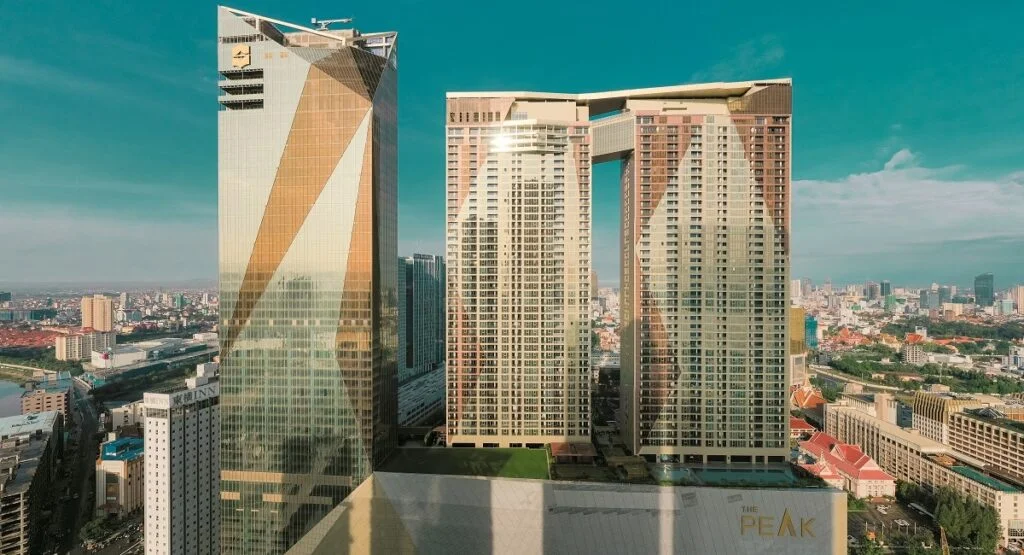
Quick answer: The Peak is Oxley Worldbridge’s freehold 55-storey scheme in Tonle Bassac, 1,014 homes in two residential towers, 250 strata offices, a five-level retail podium and a Shangri-La hotel above roughly 12,609 sqm of ground. Buying here is not buying an apartment. It is buying a share of a small vertical district, and the podium below you sets the cost.
Most coverage of this scheme lists the amenities. The amenities are the liability as much as the attraction, and the documents that decide which they are for a specific unit are obtainable before you buy. Verification format as on every project page here: verified, claimed, must-obtain.
What is The Peak and who built it?
The Peak is a freehold 55-storey mixed-use development on roughly 12,609 sqm in Tonle Bassac, built by Oxley Worldbridge, Singapore’s Oxley Holdings with Cambodia’s Worldbridge Land. It holds 1,014 homes across two residential towers, 250 strata office units in a commercial tower, a five-level retail podium and a Shangri-La of over 300 rooms.
| Fact | Verified position | Note |
|---|---|---|
| Developer | Oxley Worldbridge (Oxley Holdings SG + Worldbridge Land) | Also built The Bridge nearby |
| Scale | 55 storeys, site ~12,609 sqm | Freehold strata |
| Homes | 1,014 units, two residential towers | Studio to penthouse |
| Offices | 250 strata office units | A separate market inside one address |
| Retail | Five-level podium | Shared frontage and plant |
| Hotel | Shangri-La, 300+ rooms | The city’s first |
Our read starts with the tenure, because the word freehold is doing real work here: strata title above the ground floor puts a foreign buyer’s name on the register, and that part is ordinary. What is not ordinary is how many separate businesses sit inside the same envelope. A hotel runs 24 hours with its own laundry, kitchens, plant and delivery pattern. A mall on five levels runs its own security, waste and air handling. Two hundred and fifty offices fill and empty on a weekday rhythm. Above all of it, a thousand households expect a quiet lobby. Those four operating profiles share structure, risers, and in some designs, lifts and driveways, and the paperwork that divides their costs is the most consequential document attached to a Peak apartment.
Read this against the Tonle Bassac district profile, which sets the rent band the apartments compete in, and against The Bridge, the same developer’s other scheme a short walk away. The cost machinery is explained in the sinking fund and fees guide, the commercial half in the office investment guide, and the title mechanics in foreign ownership and strata title.
How does ownership work when four uses share one roof?
Foreign buyers can hold Peak residential and office strata above the ground floor inside the 70% cap on total private-unit area, exactly as anywhere else in Cambodia. The complication is not the cap but the structure beneath it: a scheme with hotel, retail, office and residential components usually divides into separate co-ownership entities, and which one your unit belongs to changes the bill.
| Ownership item | Position here | What to demand |
|---|---|---|
| Legal basis | Strata co-ownership, Sub-Decree 126 | Certificate for your component |
| Foreign cap | 70% of total private-unit area | Ledger extract for the residential entity |
| Component structure | Residential / office / retail / hotel | Which entity holds your unit, in writing |
| Shared plant | Lifts, generators, water, security | The apportionment schedule |
| Hotel operator | Shangri-La | The operating agreement’s effect on common areas |
| Title | Individual strata title | Land Office verification |
What we could verify about the legal mechanics is that nothing here is exotic: it is the standard framework applied to an unusually layered building. The work is therefore documentary rather than legal. Ask for the co-ownership regulations of the entity your unit sits in and read the apportionment schedule first: it states what share of the generators, the pumps, the fire systems and the security contract the residential owners carry against the commercial ones. A schedule that allocates by floor area alone will usually flatter the hotel, whose consumption per square metre is several times a household’s. A schedule that allocates by metered use, or by a negotiated formula with a review mechanism, is the sign of a scheme designed by somebody who expected this question. Either way the answer is a number you can obtain today, and it recurs every month you own the unit.
The general rules sit in can foreigners buy property in Cambodia and foreign ownership and strata title; the paperwork sequence is in strata co-ownership registration and due diligence step by step. Budget for the transfer with the closing-costs guide.
What does a mall and a hotel underneath actually cost?
Recurring cost is where mixed use shows up. Phnom Penh condominium service charges run near $1.50 per sqm per month, and commercial space in the city carries $2 to $5 per sqm on top of rent, so a scheme sharing plant across both is reconciling two different cost bases inside one building. On a 70 sqm apartment the gap between a fair apportionment and a lazy one is real money every year.
| Cost input | Figure | Why it matters here |
|---|---|---|
| Condo service charge | ~$1.50 per sqm per month | ~$1,260 a year on 70 sqm |
| Commercial service charge | $2-$5 per sqm per month | The podium’s cost base, not yours |
| Shared plant | Lifts, gensets, pumps, fire, security | Apportioned by schedule, not by fairness |
| Sinking fund | Balance and spending record | A 55-storey facade is a large future bill |
| Hotel operations | 300+ rooms, 24-hour | Highest consumption per sqm in the scheme |
| Retail levels | Five | Waste, deliveries, parking pressure |
Insider tip: ask the managing agent for the last two years of actual residential service-charge collections and the same period’s spending, then divide by the residential area and compare the result with $1.50 per sqm, the gap, in either direction, tells you more about this building than any tour. A figure well below the city norm in a scheme with this much plant usually means deferral rather than efficiency, and deferred maintenance on a 55-storey tower arrives as a levy rather than a surprise. The red flag to refuse is a sales answer that quotes a headline service charge without naming which component’s budget it belongs to. In a four-use building that number is meaningless until it is attached to an entity, and an agent who cannot attach it has not read the documents they are selling from.
For the arithmetic behind recurring charges, work through the sinking fund and fees guide alongside the office investment guide, which explains the commercial cost base your podium sits on. The negotiation guide covers using running costs as leverage, property taxes and fees covers the annual charge, and the management guide covers doing all of it from abroad.
Who lives above a hotel, and who rents from you?
The tenant this scheme suits is the one who wants the podium: a household that will genuinely use a mall, a hotel gym and a lobby with a concierge, and will pay above the district’s ordinary rents for it. Central Phnom Penh lets modern one and two-bedrooms at $400 to $1,000 a month, and a Peak unit sits at the top of that range or above it, but only for tenants who value what is downstairs.
| Tenant input | Position | Note |
|---|---|---|
| Central rent band | $400-$1,000/month, 1-2BR | The Peak prices at or above the top |
| Natural tenant | Corporate, relocation, serviced-style | Values amenity and address |
| Weak fit | Price-led tenants | Pays for space, not for a podium |
| Vacancy backdrop | ~15% citywide | Premium stock is not exempt |
| Competing supply inside | Hotel rooms and serviced options | Short-stay demand has an alternative in-house |
| Exit pool | Buyers who want the same thing | Narrower and better-informed |
The methodology this corpus applies to amenity-led buildings is to ask who pays the premium and for how long, because we tracked the same pattern across the city’s serviced and branded stock: amenity supports rent while it is maintained and stops supporting it the moment it is not. Here the maintenance question is answered by a hotel operator with a global brand to protect, which is a genuine and unusual advantage: a Shangri-La cannot let the shared frontage decay without damaging itself. The offsetting fact is competition from inside the same address: a corporate visitor who might have taken a serviced apartment upstairs can take a hotel room instead, so the building partly competes with its own landlords for short-stay demand. For a twelve-month tenancy that hardly matters. For an owner planning nightly or monthly letting, it is the central question, and it should be asked before the purchase rather than after the first quiet quarter.
Model the income with the Phnom Penh rental yield guide, then check the amenity premium against serviced apartments investment and, if nightly letting is the plan, the Airbnb guide. Tax treatment is in rental income tax and the tenant evidence is in the Tonle Bassac profile.
Considering a unit at The Peak? We will identify which co-ownership entity it sits in, pull the apportionment schedule and two years of actual service-charge spending, and price the holding cost before you look at the asking price.
Get the podium analysisHow does it compare with the developer’s other Tonle Bassac scheme?
The sharpest comparison is not with another district but with The Bridge, Oxley Worldbridge’s earlier scheme a short distance away, completed in 2018. Both are large, mixed and freehold. They carry opposite risks, and a buyer choosing between them is really choosing which risk to hold.
| Dimension | The Peak | The Bridge |
|---|---|---|
| Scale | 55 storeys, 1,014 homes | 45 storeys, 734 homes |
| The other use | 250 offices, 5-level mall, hotel | 963 SOHO units |
| Main risk | Operating cost and shared access | Internal supply competing with resale |
| Delivered | Later, with the hotel | 2018, with an operating record |
| What you buy | An address with a permanent anchor | A completed building with visible history |
| Evidence available | Apportionment schedules | Eight years of letting and resale data |
Our underwriting of the pair puts them on opposite sides of the same trade-off. The Bridge has more history and a bigger internal competitor: 963 SOHO units in one scheme are a supply overhang that presses on every condo resale in the building, and no amount of good management makes them disappear. The Peak has less operating history and a different exposure: its neighbours are a hotel and a mall, which do not compete with a landlord for tenants but do compete for the building’s shared budget. A buyer who wants the smallest number of internal competitors takes The Peak and pays attention to the cost schedule. A buyer who wants a documented operating record and will underwrite around known supply takes The Bridge and prices the SOHO overhang into the offer. Both are defensible; what is not defensible is treating them as interchangeable because one developer’s name is on both.
Compare directly with The Bridge and with the wider district in the Tonle Bassac profile. The completed-versus-new decision is worked through in buy new vs resale, the city-level shortlist in best condos to buy in Phnom Penh, and the pricing method in the resale valuation guide.
What we could verify, and what an owner must obtain
| Claim | Classification | Evidence |
|---|---|---|
| Developer: Oxley Worldbridge (Oxley Holdings + Worldbridge Land) | Verified | Developer sites and Singapore listings |
| 55 storeys, freehold, site ~12,609 sqm | Verified | Developer documentation |
| 1,014 homes across two residential towers | Verified | Project breakdown |
| 250 strata office units, five-level retail podium | Verified | Project breakdown |
| Shangri-La hotel, 300+ rooms | Verified | Operator and developer announcements |
| Which co-ownership entity a unit sits in | Must obtain | Certificate and regulations |
| Shared-plant apportionment | Must obtain | The schedule, in writing |
| Residential sinking fund and spending | Must obtain | Two years of statements |
An earlier version of this page described The Peak as a “Shibuya-branded CBD condo” in Daun Penh. Both were wrong: the developer is Oxley Worldbridge and the scheme is in Tonle Bassac. The correction is recorded here rather than quietly overwritten, because a reader who acted on the old description deserves to know which parts changed.
Advantages and disadvantages
For the purchase: freehold strata in a completed landmark; a Shangri-La as a permanent quality anchor that no neighbouring scheme can replicate; genuine amenity depth for tenants who want it; a Singapore-listed developer with a second delivered Phnom Penh scheme to inspect; and a residential component large enough to have real comparable evidence inside it.
Against it: four operating profiles sharing one structure, with cost apportionment decided by a schedule most buyers never read; a hotel whose consumption per square metre dwarfs a household’s; shared access and traffic that a floor plan cannot show you; short-stay letting that competes with the hotel downstairs; and a facade and plant at 55 storeys that will eventually need a bill nobody has yet named.
Buyer scenarios and decision framework
An occupier who will actually use the podium is the scheme’s natural buyer and collects its value daily, which no tenant fully pays for. A long-let investor can make it work at the top of the central band, provided the holding cost is modelled from the real apportionment rather than a headline rate. A short-stay operator should think hard about competing with a Shangri-La inside the same walls. And a buyer choosing between this and The Bridge should decide which risk they would rather manage: a cost schedule they can read, or a supply overhang they cannot remove.
Closing verification checklist
Before any deposit: establish which co-ownership entity holds the unit and obtain that entity’s regulations; read the shared-plant apportionment schedule and model the annual cost against $1.50 per sqm; request two years of residential service-charge collections and spending; walk the residential and hotel cores at an evening hour to see how access actually separates; obtain closed resale comparables from inside the residential towers; verify title and encumbrance at the Land Office; and time the transfer against the 2026-12-31 duty window with the 20% capital gains regime from 2027 in the exit model.
Frequently Asked Questions
A freehold 55-storey mixed-use scheme in Tonle Bassac, Phnom Penh, on about 12,609 sqm, by Oxley Worldbridge, Singapore's Oxley Holdings with Cambodia's Worldbridge Land. It holds 1,014 homes in two residential towers, 250 strata offices, a five-level retail podium and a Shangri-La of over 300 rooms.
Yes, on residential and office strata above the ground floor, inside the cap of 70% of total private-unit area. Because the scheme mixes four uses, establish which co-ownership entity your unit belongs to first, that answer decides which service-charge budget you join.
It is the largest variable in the holding cost. A five-level mall, a hotel and an office tower share plant, security and lifts with the homes above. Apportionment is set in the co-ownership documents rather than by fairness, so the schedule is the document to read before the price list.
Both ways. A Shangri-La is a permanent quality anchor that supports the address and cannot let shared areas decay without damaging itself. It also brings coach traffic, events and a service population through shared entrances, so access separation is worth checking on site.
Same developer, opposite risks. The Bridge carries 963 SOHO units competing with its own condo resale. The Peak carries a mall and a hotel, so its exposure is operating cost and shared access rather than internal supply.
The co-ownership entity holding your unit; the shared-plant apportionment schedule; the residential sinking fund balance and its spending record; access separation between cores; and closed resale comparables inside the residential towers rather than asking prices across the scheme.
Frequently Asked Questions
A freehold 55-storey mixed-use scheme in Tonle Bassac, Phnom Penh, on a site of about 12,609 sqm, developed by Oxley Worldbridge, the joint venture between Singapore's Oxley Holdings and Cambodia's Worldbridge Land. It combines two residential towers holding 1,014 homes, a commercial tower with 250 strata office units, a five-level retail podium and a Shangri-La hotel of over 300 rooms.
Yes, on the residential and office strata above the ground floor, inside the cap of 70% of the building's total private-unit area. Because the scheme mixes residential, office, retail and hotel under one roof, ask which co-ownership entity your unit belongs to before anything else: the answer decides which service-charge budget you are joining.
That is the question this page exists to ask. A five-level mall, a hotel and an office tower share plant, security, lifts and frontage with the homes above them. Cost apportionment between those uses is set in the co-ownership documents, not by fairness, and it is the single largest variable in what a Peak apartment costs to hold.
It cuts both ways. A Shangri-La is a permanent quality anchor no neighbouring scheme can copy, and it supports the address. It also brings coach traffic, event nights and a service population through shared entrances, which is why access separation between hotel and residential cores is worth checking on site rather than on a floor plan.
They are the same developer's two Tonle Bassac schemes and they fail differently. The Bridge carries 963 SOHO units that compete with its own condo resale. The Peak carries a mall and a hotel, so its risk is operating cost and shared access rather than internal supply. Read both before choosing between them.
The co-ownership structure and which entity your unit sits in; the apportionment of shared plant between residential, retail, office and hotel; the sinking fund balance and its spending record; the access separation between cores; and closed resale comparables inside the residential towers rather than asking prices across the scheme.
Get a Cambodia property shortlist
Share your budget, target district (BKK1, Koh Pich, Koh Norea, Siem Reap), and goal. We reply within one business day with matched stock and next steps.