Olympia City Review: OCIC's Stadium Quarter, Priced
OCIC's mixed-use quarter beside the Olympic Stadium publishes no unit pricing. The independent read prices it anyway, from resale evidence and rent bands.
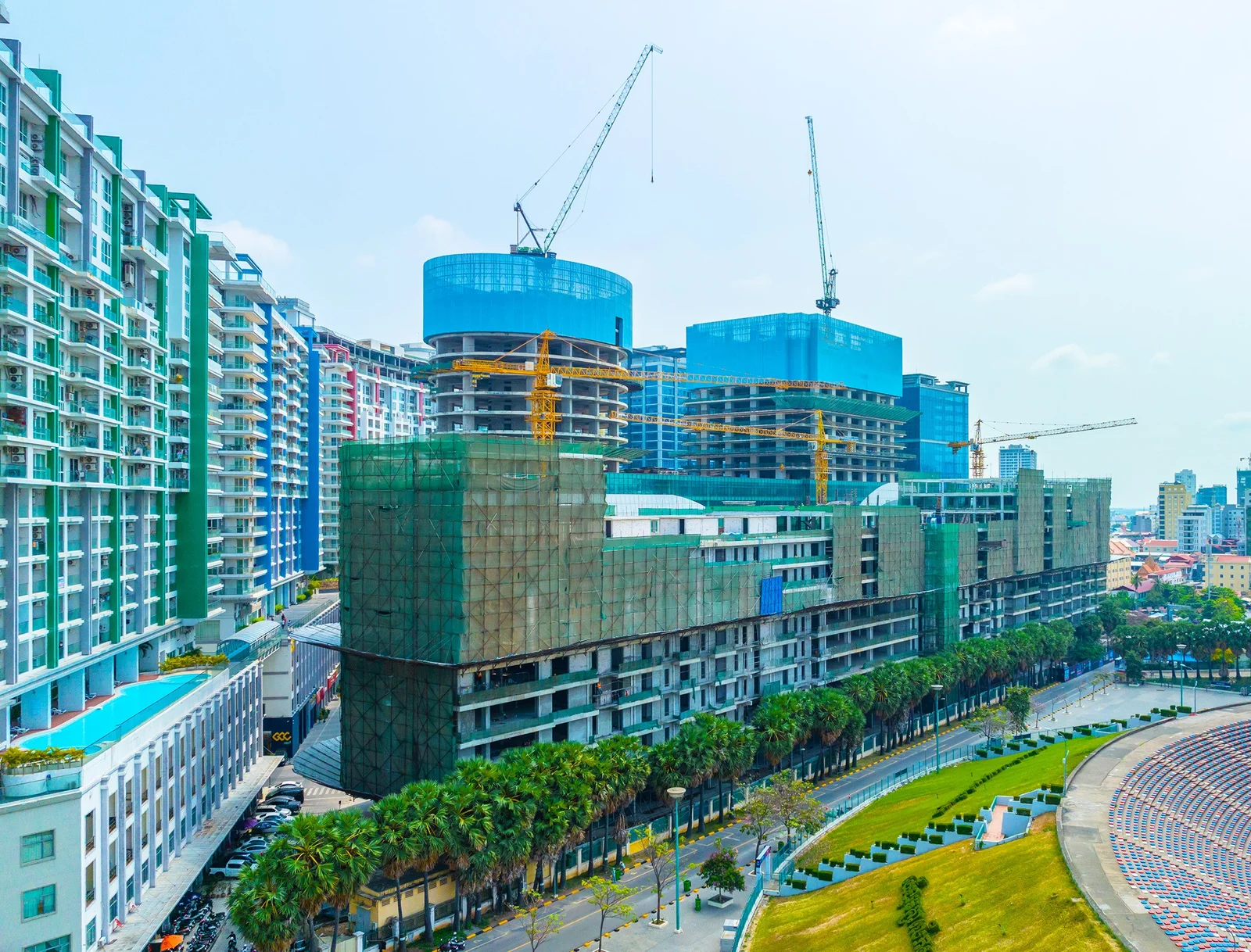
Quick answer: Olympia City is OCIC’s completed-in-phases mixed-use quarter beside the Olympic Stadium, about 68,000 sqm of condo towers, a 25-storey SOHO line and Olympia Plaza mall, building since 2013. The developer publishes no unit pricing, so this page prices it the only honest way: from the $1,800 per sqm city anchor, in-quarter resale evidence, and real rents.
The defining fact of this project’s search results is an absence: no developer price list, and a dozen agency pages filling the void with their own numbers. This page refuses to add another. It applies the corpus’s verification format: verified, claimed, must-obtain, to a quarter that has been standing long enough to answer honestly.
What is Olympia City and who builds it?
Olympia City is a mixed-use quarter of about 68,000 sqm beside the National Olympic Stadium in 7 Makara, built in phases since 2013 by The Olympia City Development Co., Ltd, an OCIC affiliate financed by Canadia Bank. The developer delivers condominium towers, a 25-storey SOHO line, and the Olympia Plaza mall.
| Fact | Verified position | Note |
|---|---|---|
| Developer | The Olympia City Development Co., Ltd | OCIC affiliate, Canadia Bank financing |
| Site | ~68,000 sqm beside the Olympic Stadium | Veal Vong, 7 Makara |
| Building since | 2013, phased | Over a decade of visible delivery |
| Products | ~20-storey condos, 25-storey SOHO, mall, hotel, school, medical hub | Genuine mixed use |
| Pricing | No published unit price list | The SERP’s defining absence |
| Status | Completed phases occupied | Occupancy is observable, not projected |
Our read of Olympia City starts from what a decade of phases proves: OCIC’s affiliate has been delivering on this site since 2013, through every cycle the market has thrown at it, with a bank behind it whose name is on the group’s own letterhead. That makes the quarter a case study in the difference between master-plan risk and master-plan reality: the risk version is a render with a decade of promises ahead; the reality version is a mall with foot traffic, towers with lit windows, and a school term calendar. What the longevity does not do is guarantee value: phased quarters deliver their best buildings and their weakest into the same address, and a 2013-phase tower and a recent one share a brand, not a spec. The buyer’s work here is unit-level, and the quarter’s age is what makes that work possible at all.
- The developer group in full: OCIC developer guide.
- The district context: BKK3 area profile borders the stadium quarter.
- The island sibling: Koh Pich area profile.
- The pricing method this page applies: resale valuation guide.
- What condos cost citywide: how much does a condo cost.
How does foreign ownership work across a mixed-use quarter?
Foreign buyers can hold Olympia City’s strata products, condominiums and SOHO units above ground floor, inside the standard cap of 70% of total private-unit area per co-ownership building. A quarter built in phases since 2013 means multiple separate buildings, each with its own quota ledger, which is exactly what a buyer must request per building.
| Ownership item | Position here | What to demand |
|---|---|---|
| Legal basis | Strata co-ownership, Sub-Decree 126 | Per-building certificate |
| Foreign cap | 70% of total private-unit area, per building | Ledger extract for YOUR building |
| Condo vs SOHO | Both strata, different regulations | Co-ownership rules on commercial use |
| Ground floor | Not foreign-eligible | Confirm floor in the title |
| Building age | Up to a decade of transfers | Encumbrance search is essential |
| Title | Individual strata title per unit | Verify at the Land Office |
Our analysis of the ownership mechanics flags the one trap specific to master-plan quarters, and it belongs at the top of any checklist: the project name is not the legal unit of ownership, the building is. Quota headroom, co-ownership regulations, sinking funds and management contracts all attach per building, so “Olympia City is foreign-eligible” is a true sentence that decides nothing about the specific tower a buyer is quoted. In a quarter where towers have been selling since 2013, some buildings will carry near-empty foreign ledgers and others may run close to the 70% area cap; the difference is a one-page extract a serious seller can produce in days. The SOHO line needs one extra document, the regulations’ commercial-use provisions, because a unit marketed for living and working must actually permit both, and the clause that says so is in the co-ownership rules, not the brochure.
- The legal foundation: can foreigners buy property in Cambodia.
- The cap, correctly stated: foreign ownership and strata title.
- Registration mechanics: strata co-ownership registration.
- Ten pre-purchase questions: strata title FAQ.
- The full process: due diligence step by step.
How do you price a project with no price list?
Pricing Olympia City requires method, not a brochure: the developer publishes no current unit prices, so the honest anchors are the $1,800 per sqm city average, resale evidence inside the quarter’s completed towers, and central rent bands of $400 to $1,000 a month. Every agency number filling that vacuum is an ask wearing a uniform.
| Pricing input | Figure | Role in the method |
|---|---|---|
| City average | ~$1,800 per sqm | The anchor every quote must justify deviating from |
| BKK1 premium contrast | $2,800-$3,500 per sqm | The ceiling central Phnom Penh pays |
| In-quarter resales | Closed transfers, per building | The only building-specific truth |
| Rent sanity check | $400-$1,000/month central bands | Price ÷ realistic annual rent |
| Service charge | ~$1.50 per sqm per month | Recurs; capitalise into the offer |
| Agency quotes | Asks | Data about sellers, not about value |
Insider tip: a missing price list is leverage, not an obstacle, the methodology that fills it works in the buyer’s favour precisely because most participants never run it. Start at the $1,800 per sqm anchor and demand justification in either direction: stadium-side convenience, in-quarter amenities and newer phases argue above; 2013-phase spec, SOHO ambiguity and 7 Makara’s non-premium rents argue below. Then require two closed comparables from the same building, not the quarter, the building, and translate the quoted price into a rent multiple: at $500 to $900 a month, which is where we tracked most non-BKK1 central stock, a $150,000 ask needs roughly $750 a month just to gross 6%. The red flag is a seller who cannot name a single closed transfer in their own building while quoting a price with confident precision; in a quarter this old, that combination means the number came from hope, not history.
- The valuation method in full: resale valuation guide.
- The citywide price map: how much does a condo cost.
- Negotiating without a list price: the negotiation guide.
- Every cost beyond the price: closing costs guide.
- The entry-tier contrast: Megakim vs OCIC entry pricing.
What rental case does the stadium quarter support?
The rental case for the stadium quarter is central convenience at non-BKK1 money: this market rents modern one to two-bedrooms at $400 to $1,000 a month in central districts, and Olympia’s tenant draw is the mall, the schools and the medical hub downstairs. Vacancy averages about 15% citywide, and a decade-old quarter shows its occupancy honestly.
| Yield input | Figure | Note |
|---|---|---|
| Central rent band | $400-$1,000/month, 1-2BR | Olympia sits mid-band |
| In-quarter drivers | Mall, school, medical hub | Amenity demand that already exists |
| Vacancy backdrop | ~15% citywide | Observable here, not theoretical |
| Gross yield frame | 5-7% citywide realistic | On evidence-based pricing |
| Net, modelled | 3-5% | After voids, management, service charge |
| SOHO tenants | Residents plus small businesses | Different churn, different leases |
The quarter’s genuine rental advantage is one we could not confirm for any off-plan competitor, because it only exists after a decade of operation: the amenities that drive tenancy are open, staffed and measurable rather than promised. A tenant here walks downstairs to a functioning mall, sends children to a school that holds classes, and reaches a medical hub without crossing the city, and an investor can stand in the lobby at 7pm and count the evidence before making an offer. The honest counterweights: 7 Makara rents mid-band, not premium, so underwriting BKK1 numbers against stadium-quarter stock is self-deception; the SOHO line’s business tenants churn differently from households and lease differently too; and 15% citywide vacancy applies to old central stock with full force. Model mid-band rent, real voids, and the $1.50 per sqm service charge, and the quarter supports the corpus’s 3-5% net band without requiring a single optimistic assumption.
- The full yield model: Phnom Penh rental yield guide.
- Managing tenants from abroad: property management guide.
- Tax on rental income: rental income tax.
- The recurring costs: sinking fund and fees.
- Central district contrasts: BKK3 profile and Tonle Bassac.
Quoted a price at Olympia City? We will test it against closed resales in that specific building, pull the building's quota ledger, and give you the rent-multiple math before you respond to the ask.
Price this quarter properlyHow does it compare with OCIC’s island projects?
The instructive comparison is inside the OCIC family itself: Olympia City is the landlocked, completed central quarter, while Koh Pich carries the island premium, entry from about $106,000, trading well above the $1,800 per sqm city average, and Koh Norea sells the next island’s promise. For foreign buyers the trade is finished central density against waterfront branding.
| Option | Positioning | Status | The trade |
|---|---|---|---|
| Olympia City | Central, stadium-side, mid-band | Phases completed since 2013 | Evidence over prestige |
| Koh Pich | Island premium, from ~$106,000 | Established, still building | Brand and waterfront at a premium |
| Koh Norea | The next island | Early, promise-stage | Master-plan risk, full price |
| City average | ~$1,800 per sqm | n/a | The anchor all three deviate from |
| Rent reality | $400-$1,000 central bands | n/a | Applies to all central stock |
| Family trait | OCIC master-planning | n/a | Same machine, three risk stages |
Our underwriting of the three-way family comparison produces a clean buyer scenario ladder, ordered by how much of the purchase is evidence and how much is story. Olympia City is the evidence end: completed stock, observable occupancy, per-building ledgers, mid-band rents, the discount for its lack of glamour is real and measurable, which is precisely what makes it useful. Koh Pich is the middle: an established island brand whose premium over the $1,800 average is sustained by end-user prestige demand, and whose yields are correspondingly thinner. Koh Norea is the story end: the same master-planning machine, sold before the evidence exists. A buyer’s position on that ladder should match their verification appetite, not the brochure’s photography, and the family’s own history offers the test: everything Koh Norea promises, Olympia City once promised too, and the stadium quarter’s current resale pricing is the market’s settled verdict on what OCIC master-plans are worth once the ribbon-cuttings end.
- The island premium, examined: Koh Pich area profile.
- The next island’s pitch: OCIC Koh Norea review.
- The group behind all three: OCIC developer guide.
- Promise-stage discipline: off-plan property guide.
- The city shortlist: best condos to buy 2026.
What we could verify across a decade of phases
| Claim | Classification | Evidence |
|---|---|---|
| Developer: The Olympia City Development Co., Ltd (OCIC affiliate) | Verified | Group and portal sources agree |
| Canadia Bank financing | Verified | Group structure, publicly stated |
| ~68,000 sqm site beside Olympic Stadium | Verified | 7 Makara, Veal Vong |
| Building in phases since 2013 | Verified | Over a decade of visible delivery |
| Product mix: condos, SOHO, mall, hotel, school, medical hub | Verified | Operating, not planned |
| Current unit pricing | Not published | The developer releases no list |
| Any specific asking price | Tier C | Agency asks fill the vacuum |
| Per-building quota, sinking funds | Must obtain | Building-level documents, dated |
The verification table for Olympia City is unusual in the corpus: almost everything structural is verified, and almost everything financial is absent. That combination is not a defect: it is the shape of a mature project whose developer no longer needs to advertise, and it moves the entire burden of pricing onto the buyer’s method. The method is this page’s third section; the documents are the must-obtain rows; and the discipline is refusing every number that arrives without a closed transaction behind it.
Two practical notes on running that discipline here. First, the quarter’s age makes the encumbrance search matter more than at any new launch: a title that has changed hands two or three times since 2013 can carry history, undischarged mortgages, disputed transfers, unpaid obligations to the co-ownership: that a launch-day title cannot, and the Land Office search is the only instrument that surfaces it. Second, treat the mall and amenity floors as a separate commercial reality: their tenancy health is public information available to anyone who walks through, and a visibly struggling podium in any specific phase is a leading indicator for that building’s service-charge collections and sinking-fund strain. The quarter as a whole has passed a decade of market tests; a buyer’s job is to confirm their particular building passed them too.
Advantages and disadvantages
For the purchase: completed central stock with a decade of operating evidence; amenities that exist rather than render; OCIC-family delivery credibility with bank financing structurally attached; per-building verification that is actually possible; and mid-band pricing logic that rent evidence can support without heroics.
Against it: no published pricing, which the unprepared experience as agency-quote roulette; phase-to-phase spec variance inside one brand; 7 Makara’s mid-band rents capping the income case; SOHO ambiguity that requires reading co-ownership rules most buyers skip; and the standing truth that a decade-old quarter competes against the city’s newest towers on age every single year from here.
Buyer scenarios and decision framework
An evidence-first investor who wants central Phnom Penh without paying BKK1 or island premiums is the natural buyer: the quarter rewards exactly the verification work it makes possible. An occupier valuing walk-downstairs amenity over address prestige gets more functioning city here than almost anywhere at the price. A SOHO buyer with an actual small business is buying a genuinely fit product, provided the regulations permit the use in writing. And a buyer drawn to the OCIC brand who has not yet chosen a project should run this page’s family ladder deliberately: the same machine sells evidence here, prestige on Koh Pich, and promise on Koh Norea, at three different prices for three different risks.
Closing verification checklist
Before any offer: identify the exact building and obtain its quota ledger extract in square metres; require two closed comparables from that building and run the per-sqm figure against the $1,800 anchor; translate the ask into a rent multiple against the $400-$1,000 band; read the co-ownership regulations, commercial-use clauses included for SOHO; run the Land Office encumbrance search on the specific title; review the sinking-fund statement of a building old enough to have spent from it; and time the transfer against the 2026-12-31 duty window with the 20% capital gains regime arriving from 2027. A quarter that has stood since 2013 will answer every one of these questions: the only buyers it punishes are the ones who never asked.
Frequently Asked Questions
A mixed-use quarter of about 68,000 sqm beside the National Olympic Stadium in 7 Makara, Phnom Penh, built in phases since 2013 by The Olympia City Development Co., Ltd, an OCIC affiliate financed by Canadia Bank. The quarter combines condominium towers of around 20 storeys, a 25-storey SOHO line, Olympia Plaza mall, a hotel, a school and a medical hub.
Yes: the condominium and SOHO products are strata co-ownership buildings, so foreign buyers can hold units above the ground floor in their own name, inside the 70% cap on each building's total private-unit area. Because the quarter contains multiple separate buildings, quota headroom must be requested per building, not per project.
The developer publishes no current unit pricing, the defining fact of this SERP. Price it from evidence instead: the roughly $1,800 per sqm city average as anchor, closed resale comparables inside the quarter's completed towers, and the rent a unit actually achieves. Any specific number an agency quotes is an ask until a closing proves it.
Central Phnom Penh rents modern one to two-bedrooms at $400 to $1,000 a month, and Olympia sits squarely in that band with its own demand drivers, the mall, school and medical hub within the quarter. Against evidence-based pricing, that supports the citywide 5-7% gross, 3-5% net planning band.
No. SOHO (small office / home office) units are a hybrid strata product: legally holdable by foreigners like a condo, but underwritten differently, tenant demand includes small businesses, co-ownership rules on commercial use matter, and the resale audience is narrower. Read the co-ownership regulations before treating a SOHO as an apartment with a nicer name.
Same family, different products. Koh Pich is OCIC's island premium, entry from about $106,000, trading well above the $1,800 per sqm average. Olympia City is the landlocked completed alternative: central, dense, measurable, without the waterfront branding. Buyers paying the island premium should first check what the stadium quarter's resale evidence charges for central convenience.
Get a Cambodia property shortlist
Share your budget, target district (BKK1, Koh Pich, Koh Norea, Siem Reap), and goal. We reply within one business day with matched stock and next steps.