Buying vs Renting in Phnom Penh: The 2026 Arithmetic
Price-to-rent near 11-12x gross favours buying; opportunity cost and exit risk complicate it. Worked 5-year break-even and the variables that decide.
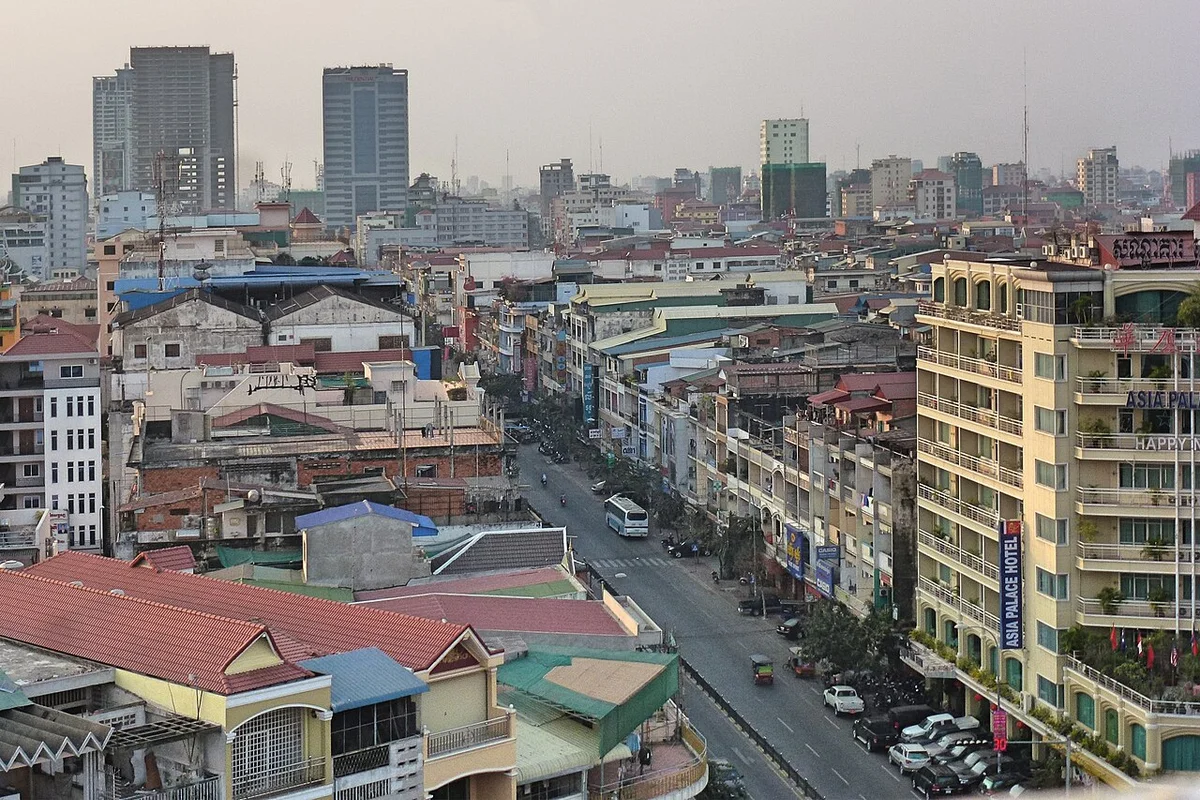
Quick answer: Phnom Penh’s price-to-rent multiple, modelled from documented bands, sits near 11 to 12 times annual rent, cheap enough that buying beats renting on raw cash flow. The full accounting is closer: completion overhead of 11% to 16%, thin resale, and the opportunity cost of $130,000 of capital make horizon the real decider, and the honest line is about 5 years.
This page answers the occupier’s question with the occupier’s numbers. The investor’s version of the same arithmetic lives in the break-even analysis, and the monthly budget around it in cost of living in Phnom Penh.
What does renting in Phnom Penh actually cost?
Renting in Phnom Penh costs $400 to $1,000 a month for a modern one to two-bedroom, with BKK1 one-beds at $650 to $1,350 and serviced apartments at $600 to $1,200 all-inclusive. Behind the bands sits the renter’s structural advantage: a market carrying 15,000 to 20,000 vacant units negotiates.
| Item | Documented position | Renter’s meaning |
|---|---|---|
| Modern 1-2BR | $400-1,000/mo | The core band |
| BKK1 one-bed | $650-1,350/mo | The premium district’s ask |
| Serviced, all-in | $600-1,200/mo | Utilities and cleaning inside |
| Vacant units | 15,000-20,000 | Landlords compete for you |
| Average vacancy | ~15% | Renewal leverage, annually |
| Deposit norms | 1-2 months | Your capital stays yours |
Our read of the renter’s case is that it is systematically undersold by everyone with something to sell, so it deserves its full strength stated: a tenant in this market chooses from thousands of near-identical furnished units, negotiates rent at signing and again at renewal against a landlord staring at 15% average vacancy, relocates for a new job or school for the cost of a deposit swap, and holds zero exposure to the market’s real risks, the quota position, the sinking fund, the 2027 tax boundary, the resale queue. The arithmetic that flatters buying below never includes the renter’s option value, and for one buyer scenario it is decisive: anyone whose Phnom Penh horizon is uncertain, a 2-year posting, a first year testing the city, a business still proving itself, is being paid flexibility worth real money to stay out of ownership, in a city where staying out costs $400 to $1,000 a month.
- Budget the whole month around the rent: cost of living in Phnom Penh.
- The bands by district: the rental yield guide from the tenant’s side.
- Serviced vs unserviced trade-offs: serviced apartments.
- Why landlords compete is in occupancy rates, and where expats actually rent in best areas.
What does buying actually cost, priced honestly?
Buying the unit a renter occupies costs its price plus 11% to 16% to complete, then a running cost most occupier arithmetic omits. A $130,000 BKK1 one-bed, the documented band’s middle, absorbs roughly $146,900 of capital by the day the furniture arrives, and about $1,600 a year thereafter.
| Line | Amount | Note |
|---|---|---|
| Purchase price | $130,000 | Mid-band BKK1 one-bed |
| Completion overhead | ~$16,900 at 13% | Transfer tax, legal, registration, furnishing |
| Service charge | ~$990/yr at $1.50/sqm on 55 sqm | Payable occupied or not |
| Property tax | ~$105/yr | 0.1% above ~$24,570 |
| Maintenance provision | ~$500/yr honest | Things break; owners pay |
| Exit, later | 3% commission; 20% CGT on gains from 2027 | The door out is not free |
What we could verify fills this table from the corpus’s own pages, the completion arithmetic from the total-cost calculator, the holding lines from the registry, and the honest addition an occupier’s version needs is the line item nobody prints: capital charge. The $146,900 that ownership absorbs is capital that could earn elsewhere, and even a conservative 4% alternative return prices that at roughly $5,900 a year, more than 5 times the visible holding costs, and the single number that most changes this comparison’s answer. Our underwriting of the buyer’s case therefore states it in two honest layers: on visible cash flow, owning this unit costs about $1,600 a year against renting it at $10,800 a year, a gap of $9,200 that looks unanswerable; charge the capital honestly and the gap shrinks to nearly nothing in year 1, which is why the break-even section below works in years, and why the buyer’s real case rests on the horizon rather than on the monthly comparison.
- The completion arithmetic in full: the total cost calculator.
- What the holding lines are: the sinking fund guide.
- The exit’s price: the CGT 2027 guide.
- What $130,000 buys well: the verified shortlist, then the purchase sequence if you proceed in the buying timeline.
What does the price-to-rent multiple say here?
Price-to-rent in Phnom Penh, modelled from documented bands because no published series exists, runs near 11 to 12 times gross annual rent, cheap by any regional comparison. A $130,000 unit letting at $900 monthly is 12.0x; a $75,000 unit at $550 is 11.4x; entry stock at $45,000 against $325 runs 11.5x.
| Pairing | Price | Rent/mo | Gross multiple |
|---|---|---|---|
| BKK1 one-bed | $130,000 | $900 | 12.0x |
| Mid-market one-bed | $75,000 | $550 | 11.4x |
| Entry studio | $45,000 | $325 | 11.5x |
| Family two-bed, premium | $300,000 | $1,800 | 13.9x |
| Regional prime capitals | n/a | n/a | Commonly 20x+ |
| Source | Documented bands, modelled | Not a published statistic | Labelled as such |
Our analysis of the multiple starts with why it is low and whether the reason should scare an occupier: Phnom Penh prices ownership cheaply against its own rents partly because the risks this site documents, thin resale, quota mechanics, completion overhang, the 76,000 to 80,000 units absorbing at 3% to 4%, are priced in by the buyers who know them, and partly because USD rents in the expat bands have held while entry prices stagnated. For an occupier the reading is double-edged and worth stating both ways: at 11 to 12x, every year of occupation “returns” 8% to 9% of the price in avoided rent, which is why the cash-flow case for buying clears so easily, and the same low multiple is the market’s own confession that converting the asset back into dollars is neither quick nor guaranteed, which is why the multiple alone must never close this decision. A case study in restraint: Bangkok’s prime multiples above 20x make renting there arithmetically obvious; Phnom Penh’s 11 to 12x makes buying merely arguable, the remaining argument is the next section’s.
- The yield-side view of the same numbers: the rental yield guide.
- Why resale is the multiple’s asterisk: resale liquidity.
- The regional comparison in full: Cambodia vs Thailand.
- Supply behind the pricing sits in the market outlook; prices by district per sqm are in how much a condo costs.
Where does the 5-year break-even actually land?
The worked break-even compares 5 years of renting at $900 a month against 5 years of owning the same $130,000 unit, sold at the end. Renting costs $54,000. Owning costs about $28,800 if the unit sells at par, and the gap closes fast once the assumptions earn their keep.
| 5-year line | Renting | Owning |
|---|---|---|
| Rent, 60 months | $54,000 | n/a |
| Completion overhead | n/a | ~$16,900 |
| Holding costs, 5 years | n/a | ~$8,000 |
| Exit commission at 3% | n/a | ~$3,900 |
| Total, price flat, sold at par | $54,000 | ~$28,800 |
| Same, with 10% exit discount | $54,000 | ~$41,800 |
Insider tip: run the sensitivity rows before trusting the headline, because the $25,000 advantage owning shows at par is built from three assumptions that each deserve a stress test. Sell into this market’s documented thinness at a 10% discount and the advantage nearly halves to $12,200; take 12 unrented, unsold months to exit and it shrinks again; charge the capital at 4%, roughly $5,900 a year on the full outlay, $29,400 across the term, and the visible advantage disappears entirely, leaving the decision to the intangibles. That is not an argument against buying; it is the honest shape of the argument: ownership in Phnom Penh pays the occupier who stays long enough to amortise the entry, exits patiently or never, and values what renting cannot price, a fixed housing cost in a dollarised market, freedom to renovate, and the option of converting the home into the income unit this site’s other pages model. Under 3 years, no construction of these numbers favours buying.
- The investor’s version of this model: the break-even analysis.
- The exit assumptions tested: resale liquidity.
- Converting the home to income later: the rental yield guide.
- The 2027 line on any gain: the CGT guide.
- Entry price discipline improves every row: the negotiation guide.
Want this break-even run on your actual numbers, your rent, your candidate unit, your horizon, with the sensitivity rows filled in honestly?
Run my rent-vs-buyWhich variables actually decide it?
Four variables decide this comparison, and the monthly cash flows the clichés argue about are not among them: horizon, exit quality, capital’s alternative use, and the buyer’s honesty about why they want to own. Foreign buyers who rank these first choose faster and regret less.
| Variable | Renting wins when | Buying wins when |
|---|---|---|
| Horizon | Under 3 years, or uncertain | 5 years plus, credibly |
| Exit quality | Building has quota or liquidity questions | Domestic-audience building, clean documents |
| Capital’s alternative | Money earns well elsewhere | Capital idle or defensive anyway |
| The honest why | ”Rent is wasted money” is the reason | A home, priced, wanted as one |
| 2026 specifics | CGT-era selling costs loom | Duty window rewards 2026 registration |
| Market backdrop | 15% vacancy serves tenants | 11-12x multiple serves patient owners |
Our read on the deciding variables ends with the one that masquerades as arithmetic: “rent is wasted money”, the sentence that sells more wrong condos than any brochure, and the one this page’s numbers answer directly, because $54,000 of rent across 5 years bought housing plus flexibility while $28,800 of ownership cost bought housing plus $146,900 of illiquid exposure, and neither pool was “wasted”. The variable that deserves more weight than it gets is exit quality at entry: an occupier who buys in a building with a plausible domestic resale audience, the Toul Kork and Chroy Changvar logic the corpus maps, has priced the day their plans change, while the buyer of the perfect-for-me unit in a quota-tight tower has bet their flexibility on their own forecast. The 2026 wrinkle cuts both ways and honestly: registering in 2026 catches the duty window, and selling after 1 January 2027 meets 20% CGT on gains, buy-side tailwind, exit-side headwind, netting close to neutral for a genuine occupier.
- Exit quality, mapped: the $200,000 crossover logic.
- The duty window’s mechanics: the stamp duty exemption.
- Quota tightness at entry: the strata guide.
- Family-building criteria: the verified shortlist’s occupier section.
- Retiring here changes the weights: the retirement guide.
Who should keep renting, and who should buy?
The comparison resolves into profiles more cleanly than into numbers, because the deciding variables are biographical. Renting keeps the short-horizon, the uncertain and the capital-productive; buying rewards the settled, the patient and those purchasing a home rather than an argument against rent.
| Profile | Verdict | Why |
|---|---|---|
| 2-year posting | Rent | No model reaches break-even |
| First year in the city | Rent | You do not yet know your district |
| 5-year-plus family, schools fixed | Buy, occupier-grade building | Horizon amortises entry; stability pays |
| Retiree settling | Buy, or CM2H if the visa adds value | Fixed cost in a dollarised market |
| Capital working hard elsewhere | Rent | The 4% charge decides it |
| Testing landlording later | Buy a unit that lets | The home-to-income conversion is real |
What we could verify across this comparison’s every row is a single, transferable conclusion: Phnom Penh is one of the few regional capitals where the occupier’s arithmetic genuinely permits buying, 11 to 12x gross, an 8% to 9% annual rent-avoidance return, a duty window through 31 December 2026, and simultaneously a market whose exit mechanics punish anyone who buys on arithmetic alone. The profiles above encode that double truth, and the buyer scenario this page most wants to prevent is the arithmetically-seduced 2-year expat; the one it most wants to enable is the 6-year family that has been renting at $1,100 in a building it could own: that household is donating its landlord roughly $13,000 a year of the market’s cheapest ownership, and this page’s entire method exists to tell those two readers apart. Both exits from this page are open: the shortlist for buyers, and an honest lease renewal for everyone else.
- Buyers: start at the verified shortlist, occupier section.
- Then the process: how to buy property in Cambodia.
- Retirees: the retirement purchase guide and CM2H.
- Renters staying renters: cost of living optimises the other side.
- Landlording later: property management for the conversion.
Advantages and disadvantages at a glance
| Renting | Buying |
|---|---|
| Total flexibility, deposit-deep commitment | Fixed housing cost in a dollarised market |
| 15% vacancy negotiates for you annually | 11-12x multiple is regionally cheap |
| Zero exposure to quota, fund, exit risks | Home equity instead of rent receipts |
| Capital free to work elsewhere | Renovation freedom, permanence |
| No 11-16% entry, no 3% + CGT exit | Convertible to an income unit later |
| Horizon-proof | Horizon-dependent, the honest one-word summary |
Two honest footnotes to the model. First, rents move: the bands used here are 2026’s, and a renter’s five-year cost assumes renewals near them, Phnom Penh’s supply overhang has held rents flat for years, which favours the renting column, but a supply cycle that finally clears would erode it; watch absorption and discount the forecasts. Second, the model prices a like-for-like unit, and real households rarely hold that constant, owners systematically buy bigger than they rented, which loads the ownership column with lifestyle upgrade masquerading as housing cost. Run the comparison on the unit you would actually rent, then decide separately whether the upgrade is worth its own price; letting the two decisions merge is how the arithmetic gets blamed for a choice it never made.
If the answer is buy. The order is unchanged from every other route into this market: district before building, building before unit, documents before money, and the entry discipline improves every row of the model above, because a unit bought 8% under its band through the negotiation method starts its break-even clock two years early.
Closing verification checklist
Before deciding: state your honest horizon in years and apply the 3/5 rule, under 3, rent; over 5, model buying; between, weight the intangibles. If buying: run this page’s break-even with your rent and your candidate unit’s documented band; charge the capital at your real alternative return; check the building’s exit quality, quota headroom, domestic audience, accounts, before its finishes; register inside the duty window if completing in 2026; and buy an occupier-grade unit in a building you verified through due diligence step by step, because the worst outcome this comparison produces is not overpaying rent: it is owning the wrong building for reasons that were arithmetic.
Frequently Asked Questions
On raw cash flow, buying usually wins: gross price-to-rent multiples modelled from documented bands sit near 11 to 12 times annual rent, which is cheap by regional standards. On the full accounting, opportunity cost of capital, completion overhead and exit risk in a thin resale market, the decision turns on horizon: under about 5 years, rent; over, buying starts to defend itself.
Modelled from this site's documented bands rather than published statistics, which do not exist: a $130,000 BKK1 one-bed letting at $900 a month runs 12.0x gross; a $75,000 mid-market unit at $550 runs 11.4x. Regional prime capitals commonly run 20x and above, which is the honest headline: Phnom Penh prices ownership cheaply against its own rents.
A modern one to two-bedroom runs $400 to $1,000 a month, with BKK1 one-beds at $650 to $1,350 and serviced units at $600 to $1,200 all-inclusive. Tenants enjoy a deep market: with 15,000 to 20,000 units vacant and average vacancy near 15%, renters negotiate, move cheaply, and carry none of the ownership risks.
Completion adds roughly 11% to 16%, transfer tax at 4% of assessed value, legal, registration, furnishing, then holding costs run on: service charge near $1.50 per sqm monthly, 0.1% annual property tax above about $24,570, and a maintenance provision. Selling later costs the 3% commission, and from 1 January 2027, 20% CGT on any gain for non-residents.
The worked model on this page lands near 5 years for a $130,000 unit against $900 rent, sooner if rents rise or you bought below the band, later once opportunity cost of capital is charged honestly. Under 3 years, renting wins in almost every scenario this page can construct from documented numbers.
Only with an exit plan that survives the posting ending early. A 2-year posting is a renting scenario, full stop. A 5-year-plus posting with family and schools can justify buying, but buy a unit that lets well, in a building with a domestic resale audience, so the exit does not depend on your own timeline holding.
Get a Cambodia property shortlist
Share your budget, target district (BKK1, Koh Pich, Koh Norea, Siem Reap), and goal. We reply within one business day with matched stock and next steps.